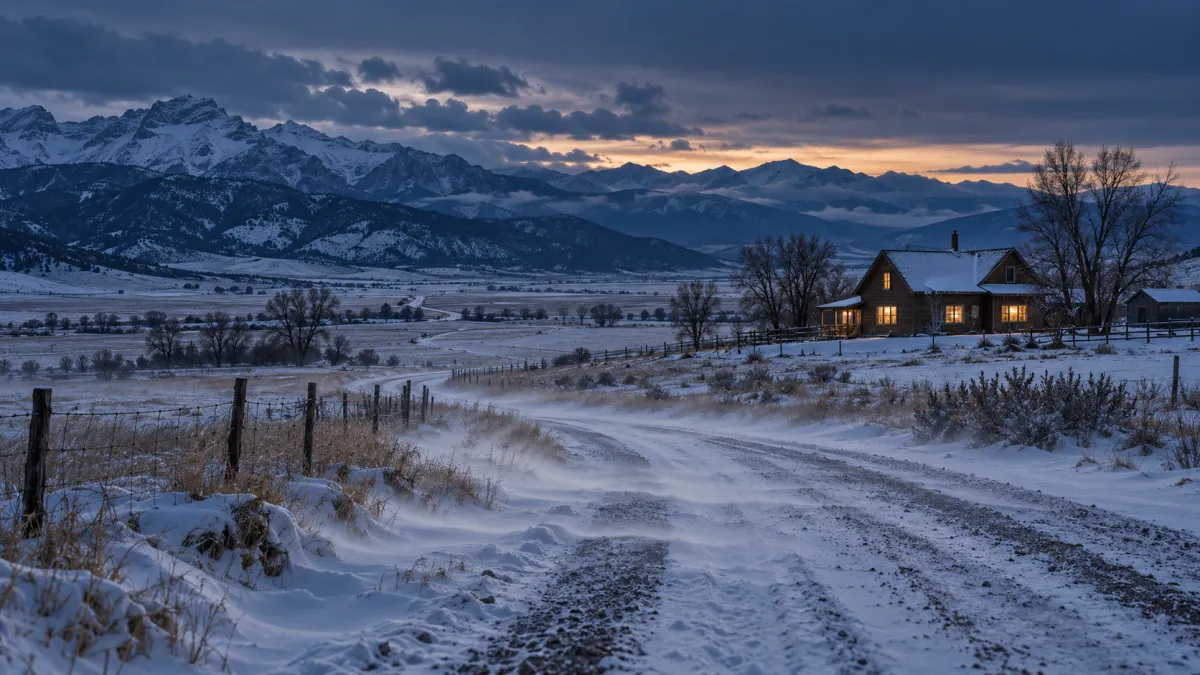
Your First Montana Winter: What Out-of-State Buyers Get Wrong
The cold is the part everyone prepares for. The wind, the dark, the distance, and the house's own systems are the parts that decide whether the first winter goes well, and every one of them is a property question before it is a lifestyle question.
If you are buying in Park County from somewhere warmer and wondering what your first Montana winter will be like, the honest answer is that the temperature is the least of it. This post covers what the winter here does to a house, a road, a heating bill, and a daily schedule, with the numbers from the weather station at the Livingston airport and the state's own records, so you can ask the right questions about a property before you own it.
What do out-of-state buyers get wrong about their first Montana winter?
They prepare for cold and get surprised by wind, dark, and distance. Livingston's winter average temperature is a few degrees below freezing, milder than most people expect. What catches new owners is a December wind that averages over 20 miles an hour, a sun that sets before 5 p.m., and a house whose heat, water, power, and road all depend on arrangements they never had to think about.
Having moved here from Florida, the pattern is familiar. The first-winter questions people ask in the fall are about snow tires and parkas. The questions they ask in February are about propane delivery schedules, who plows the last quarter mile, why the west windows whistle, and what the power co-op's outage line is. Those February questions are the ones a buyer can answer before closing, and most of the answers are written down somewhere: in a weather record, a utility territory map, a road agreement, or a heating bill.
The position this post takes: the cold is manageable, and the things that are not managed by a coat are the things to check on the property itself. The sections below go through each one, and the last section turns them into a six-line sheet you can fill out for any listing.
How cold does it get in Park County, and how much does it matter?
Colder than Florida and milder than the reputation. The 1991-2020 climate normals put the December through February average at 28.2°F at the Livingston airport and 27.9°F at the Paradise Valley station twelve miles south. The airport records about 13 nights a year at or below zero and about 35 days a year when the high stays at or below 32°F.
Those are the NOAA climate normals, the thirty-year averages the National Weather Service uses, and they are the right starting point because they are boring on purpose. A normal winter in Livingston is not a winter of endless deep cold. It is a winter of ordinary cold broken by warm spells and cut by a few sharp cold snaps. The 2025-26 winter, per the Livingston monthly climate reports from the Weather Service, bottomed out at minus 4 in December, minus 5 in January, and zero in February. Those are the coldest readings of each month, not the typical morning, and they come from a mild year: the Weather Service's Billings office reports that Livingston had its warmest meteorological winter on record in 2025-26. The year before, the 2025 annual climate summary for the same station shows minus 23 on February 11, 2025, and a 90 mph gust twelve days later. Plan for the colder year.
Here is how the four stations that matter to a Park County or Gallatin County buyer compare, all from the same NOAA data set (the four station records are one click, as a plain data file):
| Station (1991-2020 normals) | Dec-Feb average temp | Days a year the high stays at or below 32°F | Nights a year at or below 0°F | Average annual snowfall |
|---|---|---|---|---|
| Livingston airport (Mission Field) | 28.2°F | 35 | 13 | not measured at this station |
| Livingston 12 S (Paradise Valley) | 27.9°F | 36 | 10 | 62.7 inches |
| Bozeman, Montana State University | 25.1°F | 39 | 14 | 91.3 inches |
| Bozeman airport (Gallatin Field) | 22.0°F | 48 | 24 | not measured at this station |
Source: NOAA NCEI U.S. Climate Normals 1991-2020, stations USW00024150, USC00245080, USC00241044, USW00024132.
Two things in that table matter for a purchase. First, the Bozeman side of the pass is colder and snowier than the Livingston side by a real margin, roughly 30 inches more snow a year at the university station and almost twice the sub-zero nights at the airport. A buyer comparing a Livingston property to a Bozeman one is comparing two winters, not one, and the Bozeman Pass commute post covers what sits between them. Second, the Paradise Valley station at about 5,000 feet reports 62.7 inches of snow a year, which sounds like a lot until you learn that the wind moves a good share of it somewhere else, often onto the road or into a drift behind the first fence.
The warm spells have a name. A chinook, in the Weather Service's definition, is the local term for a warm, dry wind descending the east side of the Rockies, and it is the reason a January afternoon here can reach the 50s (the Livingston airport hit 59°F on January 14, 2026) and strip a yard to bare grass in a day. It is also the reason the snow that falls on your roof in December may be gone by mid-January without anyone shoveling it, and the reason the pre-freeze inspection post still tells you to check the roof's snow rating. The chinook does not come on a schedule.
What makes the cold feel colder is covered next, because it has nothing to do with the thermometer.
Why is the wind the thing nobody warns you about?
Because it is the defining fact of a Livingston winter and it does not show up in the temperature normals. The Weather Service's monthly reports for the Livingston airport put the average wind speed at 21.2 mph in December 2025 and 20.6 mph in January 2026, with peak gusts of 82 and 78 mph. In August 2026 the same station averaged 9.0 mph.
Those are monthly averages of every hourly reading, calm days included, and they come from the warmest winter in the station's record, which did nothing to quiet it. Here is December 2025 through April 2026 at the Livingston airport, month by month, with August 2026 for comparison, from the Weather Service climate summaries:
| Month | Average wind speed | Highest gust | Coldest reading |
|---|---|---|---|
| December 2025 | 21.2 mph | 82 mph (Dec 9) | -4°F |
| January 2026 | 20.6 mph | 78 mph (Jan 26) | -5°F |
| February 2026 | 18.6 mph | 74 mph (Feb 23) | 0°F |
| March 2026 | 17.1 mph | 81 mph (Mar 11) | 8°F |
| April 2026 | 13.6 mph | 69 mph (Apr 15) | 16°F |
| August 2026, for comparison | 9.0 mph | 56 mph (Aug 17) | n/a |
Source: NWS Billings, Livingston (LVM) monthly climate reports, record period 1948 to 2026.
The mechanism is the valley itself. Paradise Valley narrows to a gap where the Yellowstone River leaves the mountains at Livingston, and west-to-southwest wind coming over the divide accelerates through that gap the way water speeds up when you put a thumb over a hose. That is why the airport, which sits at the mouth of the gap, records numbers that Bozeman, 25 miles west, rarely sees. It is also why the same storm can be a breeze in Bozeman and a road closure in Livingston.
What the wind does to the temperature is arithmetic. Using the Weather Service wind chill formula, a 20°F afternoon with a 20 mph wind feels like 4°F. A 0°F morning with the same wind feels like minus 22. A 10°F day with a 30 mph wind, which the airport sees regularly in winter, feels like minus 12. The thermometer on the porch is not the number your face reads.
What the wind does to a house is the part to check before buying, and it is checkable:
- Siting and exposure. A house on an open bench with west-facing glass lives a different winter than one tucked into a cottonwood windbreak or set into a fold of the hills. On a showing, stand on the west side of the house and look for the nearest thing that would slow the wind down. If it is a mountain range 10 miles away, that is your answer.
- Where the snow goes. Wind moves snow. A driveway that runs perpendicular to the prevailing wind fills in behind every fence, hedge, and parked truck. Ask where the drifts form. The seller or the nearest neighbor usually knows to the foot, and a February visit confirms it. The road and plowing post explains why a drifted driveway is usually the owner's problem: who plows depends on the road's legal status and any recorded maintenance agreement, and the county plows only the roads on its own list.
- Roofing, siding, and anything that flaps. Gusts in the 70s and 80s, which the table above shows in four of the five months from December through April, take metal roofing that was screwed instead of clipped, lift shingles that were installed in cold weather, and turn a loose gate into a projectile. Ask when the roof went on and whether it has been re-fastened.
- Trees. Windbreaks are an asset with a lifespan. Cottonwoods drop limbs, and an old windbreak with dead trees in it is a chainsaw bill waiting for a February gust.
The interstate is the public version of the same lesson. Strong crosswinds on I-90 between Livingston and Big Timber overturn high-profile vehicles, and on March 12, 2026, wind closed the interstate near Big Timber for a few hours after semis rolled, one of them onto a Park County deputy's vehicle, according to KTVQ's report that day. If you plan to tow anything east of Livingston in winter, the Montana Department of Transportation's 511 map shows the wind alerts and closures in real time, and it belongs on your phone before you own the trailer.
What does the driving look like from November to April?
Slower, darker, and more dependent on a phone app than you are used to. Montana allows studded tires only from October 1 through May 31, chain requirements apply to vehicles towing trailers when posted, most roads into Yellowstone close to cars from early November to late April, and one national insurer's claims data ranks Montana second among states for the odds of hitting an animal.
Each of those has a source, and each one changes a small decision about the property. Take them in order.
Tires and chains. Under Montana Code Annotated 61-9-406, studded tires are permitted only between October 1 and May 31, with a longer window for school buses. The Department of Transportation's chain page explains that when chains are required in a posted area, every vehicle towing a trailer has to chain the drive wheels of one axle, and towing units of 26,001 pounds gross vehicle weight or more have to carry chains or an approved traction device from October 1 through April 30 in those areas, with an exception on the MDT page for four-wheel-drive vehicles. Passenger cars are not required to carry chains, though a posted chains-required sign can apply to any vehicle, and a set in the back of the vehicle is the cheapest insurance in the county, and Bozeman Hill, the pass between Livingston and Bozeman, is one of the places chains can be required.
The pass. The single most consequential driving fact for anyone who will work in Bozeman and live in Park County is that Bozeman Pass sits between them. The pass commute post goes through it in detail; the short version is that the road is well maintained and still closes a handful of times a winter, and a job that requires you on the other side of it every morning is a different life than one that does not.
The park. Yellowstone's park roads page states that the only road generally open year-round to regular vehicles runs from the North Entrance at Gardiner through Mammoth and Tower Junction to Cooke City, and that most park roads are closed to regular vehicles from early November to late April. For a Paradise Valley property that means the drive to Gardiner and into the park is generally open all winter on a plowed road, subject to weather closures, and the park's winter safety page lists snow tires as required equipment and warns of black ice and whiteouts. The rest of the park is a snowcoach or a snowmobile until spring.
The animals. State Farm's September 2025 analysis of its own claims put Montana second among states for the odds of an animal collision, at 1 in 53 against a national 1 in 139, with October through December accounting for 41 percent of claims. That is an insurer's claims figure, not a government count, and State Farm's September 2026 update, as reported by CollisionWeek, moved the national odds to 1 in 145. The state's own numbers point the same way. The Department of Transportation's wildlife partnership page says its crews pick up more than 6,000 animal carcasses a year and the Highway Patrol responds to an average of 3,200 wildlife-vehicle collisions annually. Deer and elk move down into the valleys in winter and cross US-89 at dusk, which starts before 5 p.m. If your commute runs the valley highway after dark from November on, budget for a deductible eventually, and drive like the deer is already in the road.
The daylight. Livingston sits at about 45.7 degrees north. On the December solstice the sun is up for 8 hours and 44 minutes, against 15 hours and 46 minutes in June, per the sunrise and sunset calendar for Livingston. Sunset comes before 5 p.m. through December. That is not a hardship, but it changes what a driveway means: a quarter mile of gravel you clear in daylight in April is a quarter mile you clear by headlight in December.
What does it cost to heat a house here, and what heats it?
It depends on the fuel, and the fuel is decided by where the property sits. Natural gas is the cheapest of the three fuels per unit of raw energy in the federal data and, around here, is largely a town utility; many rural Park County properties heat with propane, electricity, wood, or a mix, and last winter's propane ran $1.84 to $2.20 a gallon in Montana by the federal survey.
Start with the raw fuel prices, all from the U.S. Energy Information Administration, and then convert them to the same unit so they can be compared:
| Fuel | Montana residential price | Date | Raw fuel cost per million Btu |
|---|---|---|---|
| Natural gas | $8.60 per thousand cubic feet | February 2026 | about $8.30 |
| Propane | $2.12 per gallon | week of March 30, 2026 (season range $1.84 to $2.20) | about $23.20 |
| Electricity | 14.99 cents per kilowatt-hour | July 2026 | about $43.90 |
Source: EIA Montana residential natural gas price; EIA weekly Montana residential propane price; EIA Electric Power Monthly, Table 5.6.A; EIA heat content factors (91,452 Btu per gallon of propane, 1,036 Btu per cubic foot of gas, 3,412 Btu per kilowatt-hour).
Those are raw fuel costs before the appliance. Electric resistance heat turns nearly all of its energy into heat inside the house, a furnace sends some of its energy up the flue, and a cold-climate heat pump delivers more heat than the electricity it consumes, so the installed cost gap is narrower than the table. The table still tells you the order of raw fuel cost: gas, then propane, then plain electric. Delivered cost on a specific house depends on the appliance, the utility's fixed charges, and the supplier's contract, so treat the table as the starting point, not the bill. The EIA's Montana natural gas series shows the price moving through the year (it was $10.12 in June 2026, for example), the weekly propane survey only runs October through March, so a fall 2026 quote from the supplier is the current number, and the electricity table is a statewide average that your utility's actual rate will differ from; the co-op or NorthWestern bill is the real number. The conversion factors are the EIA's published heat contents.
What that means on a showing:
- Find out what the house burns. Ask which fuel heats the house, which heats the water, and whether there is a wood stove that does real work or one that is decorative. Then ask for two winters of fuel bills or propane delivery tickets, in writing. Gallons delivered is the number that survives a change in price.
- Ask who owns the propane tank. A tank the seller owns transfers with the house and lets you buy from any supplier. A tank leased from a supplier often ties you to that supplier's price and can affect whether the tank can be removed or transferred. The lease paperwork tells you which, and the difference can run to several hundred dollars a winter.
- Ask who delivers the power. Inside Livingston it is NorthWestern Energy. Across much of the rural county it is Park Electric Cooperative, which serves part of a 5,544-square-mile area covering much of Park and Sweet Grass counties and portions of Gallatin and Meagher counties. The distinction matters in a windstorm: a co-op with a small crew and long lines restores power on a different timeline than a town grid, and its after-hours outage number belongs on the refrigerator.
- Ask what happens when the power goes out. A propane furnace with an electric blower is off when the power is off. A well pump is off when the power is off. A house with a working wood stove and a properly sized generator on a transfer switch can ride out a two-day outage; a house without either one can be a frozen-pipe risk by the second night of a cold snap. The well and septic post covers the well side of that.
The cost of heat is one line on the winter sheet. The next section is the one second-home buyers skip.
What happens to a house you are not living in?
It can freeze, unless someone makes sure it does not. The Insurance Institute for Business and Home Safety recommends holding the thermostat at 55°F or higher even when no one is home, and shutting off and draining the water if the house will be empty more than a week in subfreezing weather. In a Park County winter that advice describes nearly every week from November to March.
The guidance comes from the IBHS Winter Weather Ready release of November 2024: set the thermostat to at least 55°F to keep pipes from freezing, even when no one is home, and if you will be away longer than a week with subfreezing temperatures ongoing or forecast, close the main valve slowly and let a couple of faucets on the lowest floor drain. Separately, many homeowner policies limit coverage for freezing damage in an unoccupied or vacant house unless the owner maintained heat or shut off and drained the system, and the conditions vary by insurer and by how long the house sits empty. The exact language is in your own policy and its endorsements, and it is worth reading before the first trip away rather than after the claim.
What this looks like in practice for a Paradise Valley second home:
- Someone local checks the house. Weekly in winter, after every windstorm, and after every deep cold snap. A property manager, a neighbor with a key, or a caretaker. The check is simple: furnace running, thermostat where you left it, no water on the floor, no snow through the eaves, roof load reasonable. A wifi thermostat with a low-temperature alert is the cheap backup, and it only works if the power and the internet are both up, which in a windstorm is not guaranteed.
- The water has a plan. Either the heat stays on with a remote alert and a person who can respond within hours, or the water is off at the main and the lines are drained, including the outdoor hydrants, the irrigation, and the well house. A frost-free yard hydrant only stays frost-free if it drains; one that was installed in wet ground can freeze anyway.
- The roof gets looked at. A chinook can clear it. A north-facing roof in a sheltered spot does not get the chinook. The inspection-before-freeze post covers the snow-load numbers for Park County structures and what an engineer's letter should say.
- The driveway gets plowed even when you are not coming. A house that cannot be reached by the furnace technician, the propane truck, or the person doing the weekly check is a house nobody can save when something goes wrong. Fuel suppliers often will not deliver down an unplowed drive, and a tank that runs dry in January is a furnace that stops.
- The mail and the packages have a plan. Delivery varies by carrier and by address, and on some rural routes it stops at the county road. Ask the seller and the post office.
The through-line: every one of these is a person or a piece of paper, not a gadget. New owners often arrive expecting the house to take care of itself the way a condo in a warmer place does, and the first winter teaches them that a rural house in Montana is a small system that needs an operator. Either you are the operator, or you hire one before the first freeze.
What should you write down before you buy?
Six lines, one page, for every property you consider. This is the winter sheet, and the answers to it are what separate a first winter that runs smoothly from one that runs on surprise.
- Heat. What fuel, who supplies it, who owns the tank, and the gallons or therms used each of the last two winters, from the bills.
- Power. Which utility, the outage number, the longest outage the seller remembers, and whether the house has a generator transfer switch or a wood stove that carries it.
- Water. Where the well and the pressure tank sit, whether the well house is heated, which outdoor lines drain, and what the freeze plan is when the house is empty.
- Road. Who plows, in writing, to which point, and where the drifts form. The plowing post explains the four kinds of road and what each one means.
- Wind. What faces west, what breaks the wind, when the roof went on, and what has blown off before.
- People. Who checks the house when you are gone, who the furnace technician is, who the propane driver is, and the nearest neighbor who has done a winter here.
The do-this-week version, if you are already under contract or about to be: ask the listing agent for two winters of fuel delivery tickets and the plow arrangement, both in writing, before the inspection deadline. Those two documents answer half the sheet and cost nothing.
The tradeoff to name plainly: a property that scores well on this sheet often costs more, because a sheltered site with a short, county-maintained road, natural gas at the meter, and a windbreak that took forty years to grow is scarce here, and the market knows it. A property that scores poorly can still be a good buy, as long as you are pricing in the generator, the plow contract, the caretaker, and the propane, and as long as you are honest with yourself about whether you want to be the operator. The first-year surprises post covers the rest of the adjustment, and the out-of-state buying guide covers the transaction itself.
Winter here is not the obstacle it looks like from a distance. It is a set of arrangements, and the buyers who do well are the ones who made the arrangements in September.
Frequently Asked Questions
How cold does it get in Livingston, Montana in winter?
The NOAA 1991-2020 climate normals put the December through February average temperature at 28.2°F at the Livingston airport, with about 13 nights a year at or below 0°F and about 35 days a year when the high stays at or below 32°F. The coldest readings of the 2025-26 winter, per the Weather Service's monthly reports, were minus 4°F in December, minus 5°F in January, and 0°F in February, in what the Weather Service's Billings office reports was Livingston's warmest winter on record; the station recorded minus 23°F in February 2025. Chinook winds bring warm spells between the cold snaps.
How windy is Livingston in the winter?
Very. The National Weather Service's monthly climate reports for the Livingston airport show an average wind speed of 21.2 mph in December 2025 and 20.6 mph in January 2026, with peak gusts of 82 and 78 mph. August 2026 averaged 9.0 mph at the same station. The wind comes from the west and southwest through the gap where the Yellowstone River leaves Paradise Valley, which is why Livingston records wind that Bozeman, 25 miles west, does not.
Does Bozeman or Livingston get more snow?
Bozeman. The NOAA 1991-2020 normals show 91.3 inches of average annual snowfall at the Bozeman Montana State University station and 62.7 inches at the Livingston 12 S station in Paradise Valley. The Bozeman airport also averages 24 nights a year at or below 0°F against 13 at the Livingston airport. The Livingston side has less snow and more wind, and the wind moves much of the snow that does fall.
When can you use studded tires in Montana?
Montana Code Annotated 61-9-406 permits studded tires only between October 1 and May 31 each year, with an extended window of August 15 through June 15 for school buses. The Department of Transportation's chain rules add that when it posts a chain requirement, every vehicle towing a trailer must chain the drive wheels of one axle, and towing units of 26,001 pounds gross vehicle weight or more must carry chains or an approved traction device from October 1 through April 30 in areas where chains may be required, with an exception for four-wheel-drive vehicles.
How much does propane cost in Montana?
The U.S. Energy Information Administration's weekly residential survey put Montana propane at $2.12 a gallon for the week of March 30, 2026, the last week of the 2025-26 heating season, with the season ranging from $1.84 in early October 2025 to $2.20 in mid-March 2026. The survey runs only from October through March. At 91,452 Btu per gallon, $2.12 propane is about $23 per million Btu of raw fuel, compared with about $8 for Montana residential natural gas at February 2026 prices.
What temperature should I leave a vacant house in Montana in winter?
The Insurance Institute for Business and Home Safety recommends setting the thermostat to at least 55°F to keep pipes from freezing, even when no one is home. If the house will be empty longer than a week with subfreezing temperatures ongoing or forecast, IBHS recommends closing the main water valve slowly and letting a couple of faucets on the lowest floor drain. Homeowner policies commonly limit freezing coverage in unoccupied homes unless heat was maintained or the system was drained, so read your own policy's language.
Is the road into Yellowstone open in winter from Paradise Valley?
Yes. The National Park Service states that the only road generally open year-round to regular vehicles runs from the North Entrance at Gardiner through Mammoth Hot Springs and Tower Junction to Cooke City. Most other park roads are closed to regular vehicles from early November to late April. The park lists snow tires as required winter equipment and warns of black ice, snow-packed roads, and whiteouts, so check the park's road status before leaving.
This article is general information, not legal, tax, or accounting advice. Stacy Bennin Real Estate is not a law firm or an accounting firm, and nothing here should be treated as advice from one. Laws, tax rules, and programs change, and they vary by state and by situation. Before acting on anything covered here, consult a licensed attorney and/or a certified public accountant in your state for current guidance on your specific circumstances.
The first winter here is a set of arrangements, and the best time to make them is before you close. If you are looking at property in Park County or the Yellowstone corridor and want help filling out the winter sheet on a specific listing, please reach out. Most of the answers are a phone call to the seller and a look at the west side of the house.
Stacy Bennin is a licensed real estate broker in Montana, affiliated with Legacy Lands Real Estate in Paradise Valley. She helps buyers and sellers across Park County and southwest Montana find property that fits their needs, and stays current on AI and emerging technology so her clients benefit from where real estate is headed, not just where it has been. Reach her at stacybennin.com or (406) 224-3267.
