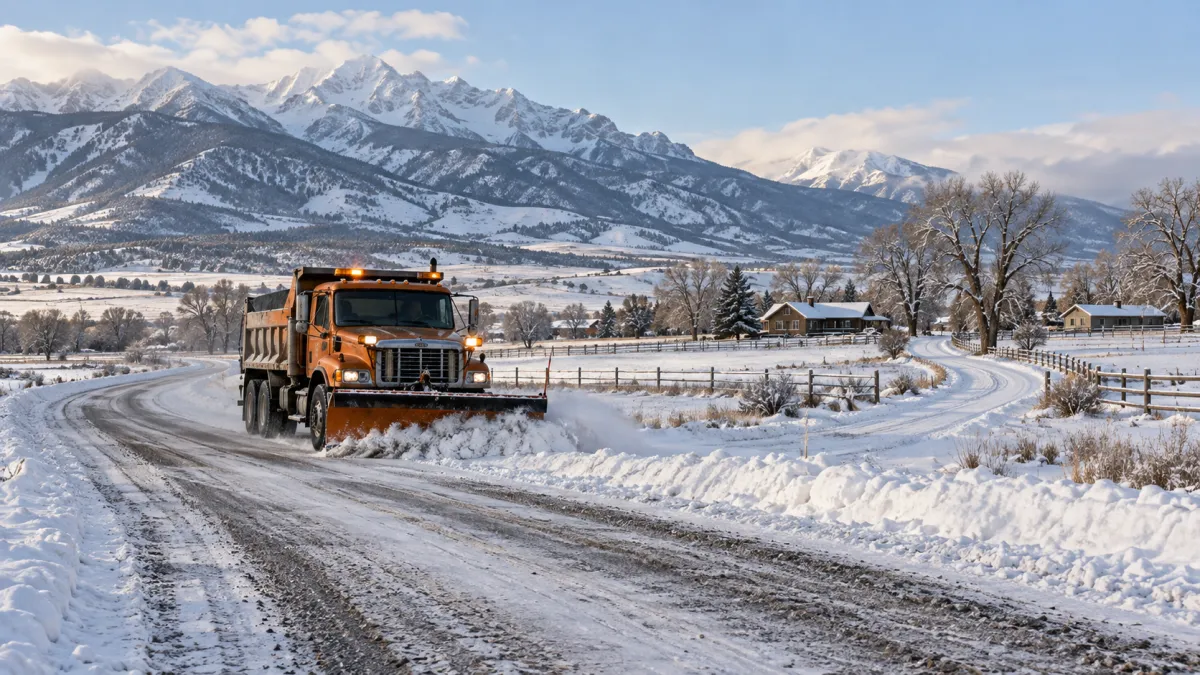
Who Plows Your Road in Park County, and What If Nobody Does?
Four kinds of road reach a Park County property, and each one has a different answer to who clears it in January. Here is how to tell which one you are buying before you close.
If you are looking at a Park County property at the end of a gravel road, the question to settle before closing is who clears that road after a storm, who pays for it, and what happens when nobody shows up. This post covers the four kinds of road you can live on here, how the county decides which of its own roads get plowed first, what Montana law says about shared private roads, and a four-step check you can run this week on any listing.
Who plows your road in Park County?
It depends on which of four kinds of road you live on. State highways are plowed by the Montana Department of Transportation. County roads are plowed by Park County Road & Bridge, in priority order, and some county roads are not plowed at all. Subdivision roads and private easement roads are plowed by whoever the owners along them arrange, or by nobody.
The four kinds, from most to least certain:
- State highways. US 89 through Paradise Valley is a state highway, part of the corridor MDT studied in its Paradise Valley Corridor Planning Study. MDT's plowing and deicing page says interstates and the highest-traffic roads are cleared first, followed by routes with progressively lower volumes, across about 25,000 lane miles statewide.
- County roads. Park County Road & Bridge is responsible for 873 miles of county roads and bridges, run out of shops in Livingston, Clyde Park, Wilsall, and Gardiner. Being a county road does not guarantee winter service; the next section covers why.
- Subdivision roads dedicated to public use. These are open to the public but are not county roads, and the county accepts no responsibility for maintaining them. Owners fund the upkeep, through an association, a district, or an agreement.
- Private easement roads. A road across someone else's land, or a shared driveway serving several parcels. The county has no maintenance role here.
The position this post takes: for any property past the end of county maintenance, the plowing answer belongs in writing before you sign a buy-sell, with the same weight as the well and the septic. A property you cannot reach in February is a different property from the one you toured in September, and the price should reflect which one you are buying.
How does Park County decide which county roads get plowed first?
Park County sorts its local roads into five tiers by traffic and school bus use, set out in the county's Transportation Standards, adopted October 2014 and still the version posted on the Road & Bridge page. Under those standards, school bus routes carrying 300 or more daily trips get first priority for plowing and sanding, and the two lowest tiers are not maintained for winter travel. Confirm the current tier for any specific road with the county.
Here is the county's own table, condensed:
| Tier | Traffic (average daily trips) | Winter plowing and sanding |
|---|---|---|
| L1 | 300 or more; school bus route | 1st priority, "to maintain travel" |
| L2 | 300 or more | 2nd priority |
| L3 | 100 to 299 | 3rd priority |
| L4 | Under 100; seasonal traffic | Not maintained for winter travel |
| L5 | Not applicable | Not maintained; county retains ownership |
Source: Park County Transportation Standards (October 2014), Table 2, Park County Local Road Classification.
Two details in that document matter to a buyer. First, the standards say school bus routes are re-evaluated annually or as needed, so a road's first-priority status can change when a route changes. Second, the standards state plainly that nothing in them obligates the county to accept any road for maintenance, whatever standard it was built to. (The same 2014 document counts 1,152 miles of county roads; the department's current page says 873. The tiers, not the mileage, are what you need.)
The mechanism is the same one every rural road department runs on: a fixed number of trucks and operators, and a storm that hits every road at once. Road & Bridge runs winter hours of 5 a.m. to 3:30 p.m., Monday through Friday, per its page. A road at the bottom of the list gets cleared after everything above it. An L4 or L5 road is not on the list at all. The county's Road Work Permit fee table lists snow plowing with the fee waived, so owners along a road the county does not plow can clear it themselves, with a permit for work in the county right-of-way.
For the daily picture on the state side, MDT's 511 road reports show current conditions on the highways. Nothing publishes conditions for county gravel or private roads, which is one more reason to know your road's tier before you need it.
What if your road is a subdivision road or a private road?
Then the county is out of the picture, and plowing is whatever the owners along the road have arranged. For subdivision roads dedicated to public use, Park County's standards say the county "accepts no responsibility for maintaining" them and that they are not county roads. Maintenance can be funded by a rural improvement district or by private agreement.
A rural improvement district, or RID, is the formal version. Under Montana Code Annotated 7-12-2102, a board of county commissioners can create a district for road maintenance on a petition from owners of more than 85 percent of the property area in it, or more than 50 percent if all the roads to be maintained are public improvements. Subsection (2)(c) adds that the property in such a district must be located in a residential subdivision, though an owner outside one can consent to be included. The county then levies an annual assessment against each parcel. Park County's RID page describes them as citizen-initiated and funded by additional taxation inside the district.
Here is the detail that surprises people. A RID on a tax bill does not mean the district pays for plowing. The county's own example, the 2015 Chicory Road RID resolution, covers about three miles of Chicory Road, River Drive, and part of Yellowstone Trail off East River Road. It funds rechipsealing on a 12-year cycle, estimated in 2015 at $126.90 per lot the first year and $82.07 per lot each year after, across 145 parcels. Section 5 lists what the district does not pay for: snow plowing, crack sealing, mowing, and other general county maintenance. A district pays for exactly what its resolution says, so read the resolution for any district that shows up on a property's tax bill, and confirm the current assessment on the bill itself.
Private easement roads have no district and no county role. Whoever holds the right to use the road arranges the plowing, usually by one of three setups:
- A recorded road maintenance agreement that names who plows, how costs split, and how decisions get made.
- A homeowners association whose covenants assign road care to the association and fund it with dues.
- A handshake. One neighbor with a tractor and a blade clears it, and the others chip in, or do not.
The first two are written to outlast a sale. A recorded agreement shows up in the title work, and covenants are drafted to bind the lots they cover, though whether a particular document binds a future owner is a question for an attorney. The third leaves with the neighbor who owns the tractor, and it is a common setup on older land splits.
What happens if nobody plows a shared private road?
Then access can stay blocked until someone with the right to clear the road does it and pays for it, and the question of who owes what comes later. Montana's Supreme Court recognized in Guthrie v. Hardy, 2001 MT 122, the general rule that the owner of an easement has both the right and the duty to keep it in repair. Without an agreement, the landowner the road crosses generally has no duty to maintain it; the upkeep falls to the easement holders, and how they share it is left to them.
In practice that rule plays out in a few predictable ways:
- The last house pays the most. The owner at the far end needs the whole road open and the owner nearest the county road needs a hundred yards of it. Without a written cost split, the far-end owner usually ends up plowing everything and asking for contributions afterward.
- Nobody decides the trigger. Four inches of snow means a plow call to one neighbor and a shrug to another. Wind moves snow in this county as much as storms drop it, so a road can drift shut on a clear day, and "we plow when it snows" does not cover that.
- Maintenance has limits. In a 2025 decision, Schubert v. Toepp, the Montana Supreme Court affirmed limits on how far an easement holder's maintenance can reach onto the land the road crosses. The dispute there was over vegetation work, not snow. The broader point for a buyer: an easement right to use and maintain a road is not a license to do whatever you like on your neighbor's side of it, including where the plowed snow goes.
- Emergency access is the real cost. An ambulance, a propane truck, and a fire engine need the same thing a car needs, an open road. A drift at the bottom of a private road is not the county's problem to clear.
None of this makes a private road a bad buy. Many of the properties people move here for sit on one, and a well-run shared road can be cheaper per household than a single long driveway. The difference between a well-run road and a winter-long argument is almost always a piece of paper.
How do you find out who plows a road before you buy?
Run the four-road check. Identify which of the four kinds of road reaches the property, confirm its status with the county, read the title work for recorded easements and agreements, and ask the seller who plowed last winter and what it cost. Each step takes a phone call or an email, and all four can happen before the inspection deadline.
- Name the road type. Start with the Montana Cadastral map, which shows parcel lines and ownership, and trace the route from the nearest highway to the property. Every change of road type along that route is a question to answer, and many properties cross two or three.
- Ask the county. Call Park County Road & Bridge at (406) 222-4137 with the road name and ask two questions: is this a county road, and what is its winter classification? The official record of county roads is the Park County Road Book, available for public viewing in the Clerk and Recorder's vault at 414 East Callender Street in Livingston, 8 a.m. to 5 p.m. weekdays.
- Read the title commitment. The exceptions in the title commitment list recorded easements, and a recorded road maintenance agreement may appear there or in the documents it references. A RID often shows up only as a general exception for taxes and assessments, so check the tax bill for district lines too. Title work is the starting point, not the last word; your title officer can pull any referenced document. A private road with no recorded agreement is the finding to act on. A land survey shows where the easement runs on the ground.
- Ask the seller for last winter. Please ask, in writing, who plowed the road last winter, how often, and what it cost, and ask for invoices if a contractor did it. Check the parcel's tax bill on the Park County Treasurer's online system for special assessment lines.
Why step four matters as much as the other three: Montana's seller disclosure law, MCA 70-20-502, requires a seller to disclose adverse material facts they know about. Its list of required topics names title, water, wastewater, utilities, structures, soil, and hazards. Road maintenance is not on the list by name. A known road problem can still qualify under the catch-all for "any other adverse material fact" when it materially affects the property, but whether a given plowing arrangement counts depends on the facts. The statute also says the seller is not obligated to investigate. The law also covers only residential property, defined in MCA 70-20-501 as property improved by a building intended as a residence with one to four dwelling units, or an individually owned unit such as a condominium. On a bare land purchase, that residential disclosure statement generally does not apply. A seller who never thought of the neighbor's tractor as an arrangement may not mention it. You have to ask.
Do the first two steps this week on any property you are serious about. They cost nothing, and the answer to step two changes what the rest of the purchase should look like. This fits inside the same calendar as the inspections to finish before the ground freezes, and it is the kind of detail that shows up on every list of expensive mistakes out-of-state buyers make in Montana.
What should a road maintenance agreement cover?
A useful agreement answers six questions in writing: who plows, when, how the cost splits, how decisions get made, what happens when a lot sells, and how disputes get settled. It is recorded with the Clerk and Recorder so it appears in title work. The drafting belongs with a Montana real estate attorney, and each of these is worth raising with them.
- Who plows. A named contractor, a rotating owner, or the association. If it is one owner with a tractor, say what happens when that owner is away or sells the tractor.
- The trigger. A snow depth at which the plow goes out, and a line covering drifts, since wind closes roads here without new snow.
- The cost split. Equal shares are simple. Shares by distance traveled on the road are fairer to the owner nearest the county road. Either works if it is written down.
- Decisions. How owners approve a new contractor, gravel, or a culvert, and what vote it takes.
- Sales. Whether the agreement binds future owners. Recording gives future buyers notice, and your attorney can draft it so it is meant to run with the land.
- Disputes. Mediation before court, and who pays for it.
If you are buying on a private road with no agreement, three options are on the table: negotiate the agreement with the neighbors before closing, price the uncertainty into your offer, or walk away. Fall is the season a buyer has room to do the first, because sellers who have not closed by November are looking at a winter of carrying costs, which is the central argument for buying in the fall. A seller who wants to close before the snow has a reason to help organize the neighbors now.
Here is the whole check in one place:
| Road type | Who plows | Who pays | How to confirm |
|---|---|---|---|
| State highway (US 89) | MDT, highest traffic first | State | MDT 511 road reports |
| County road, tiers L1 to L3 | Park County Road & Bridge, in priority order | County taxes | Call (406) 222-4137; Park County Road Book |
| County road, tiers L4 and L5 | Not the county; owners may plow with a county Road Work Permit | Owners who plow | Same call; ask the tier |
| Subdivision road dedicated to public use | Owners' arrangement; county accepts no responsibility | HOA dues, RID, or agreement | Covenants, RID resolution, title commitment, tax bill |
| Private easement road or shared driveway | Easement holders, per agreement or by default | Easement holders | Recorded agreement in title work; seller's invoices |
Source: Park County Transportation Standards (2014), Park County Road & Bridge, MDT, Guthrie v. Hardy (2001).
Frequently Asked Questions
Does Park County plow private roads?
No. Park County Road & Bridge maintains county roads only. The county's Transportation Standards define a private road as one owned, controlled, managed, and maintained by a private party, and state that the county accepts no responsibility for maintaining subdivision roads dedicated to public use. Plowing on those roads is arranged by the owners along them, through an agreement, a homeowners association, or a rural improvement district.
How do I find out if my road is a county road in Park County, Montana?
Call Park County Road & Bridge at (406) 222-4137 with the road name and ask whether it is a county road and what its winter classification is. The official record is the Park County Road Book, available for public viewing in the Clerk and Recorder's vault at 414 East Callender Street in Livingston, 8 a.m. to 5 p.m., Monday through Friday.
Which county roads get plowed first in Park County?
Under the county's 2014 Transportation Standards, school bus routes with 300 or more average daily trips (tier L1) get first priority for winter plowing and sanding, other roads with 300 or more trips (L2) get second, and roads with 100 to 299 trips (L3) get third. Tier L4 roads, under 100 trips with seasonal traffic, and tier L5 roads are not maintained for winter travel. Confirm a specific road's current tier with Road & Bridge at (406) 222-4137.
Who is responsible for maintaining a shared private road in Montana?
In Guthrie v. Hardy (2001), the Montana Supreme Court recognized the general rule that the owner of an easement has both the right and the duty to keep it in repair. The landowner the road crosses generally has no duty to maintain it absent an agreement. When several owners share a road, a recorded road maintenance agreement sets out who plows and how costs split. Without one, the arrangement is informal, and a Montana real estate attorney can explain how the rule applies to a specific road.
Does a rural improvement district pay for snow plowing?
Only if its resolution says so. Each RID's resolution defines what it maintains. Park County's 2015 resolution of intent for the Chicory Road RID covers rechipsealing of about three miles of road, estimated at $82.07 per lot per year after the first year, and lists snow plowing among the items not included. Read the resolution for any RID that appears on a property's tax bill.
Do Montana sellers have to disclose who plows the road?
Montana's seller disclosure law, MCA 70-20-502, requires sellers to disclose adverse material facts they know about. Its list of required topics does not name road maintenance; a known road problem can qualify under the catch-all for other adverse material facts when it materially affects the property, and the seller is not obligated to investigate. The disclosure statement applies to residential property (one to four dwelling units, or an individually owned unit such as a condominium), and generally not to bare land. Ask the seller in writing who plowed last winter, how often, and what it cost.
Can I buy a property on a private road with no maintenance agreement?
Yes, and many buyers do. The options are to negotiate a recorded agreement with the neighbors before closing, price the uncertainty into the offer, or pass on the property. A Montana real estate attorney can draft an agreement covering who plows, the snow depth that triggers it, how costs split, and whether it binds future owners.
This article is general information, not legal, tax, or accounting advice. Stacy Bennin Real Estate is not a law firm or an accounting firm, and nothing here should be treated as advice from one. Laws, tax rules, and programs change, and they vary by state and by situation. Before acting on anything covered here, consult a licensed attorney and/or a certified public accountant in your state for current guidance on your specific circumstances.
Every property in this county has a winter address as well as a summer one: the road you will be driving in February, and the name of whoever clears it. If you are looking at a place past the end of a county road and want help running the four-road check before your inspection deadline, please reach out. It is usually two phone calls and one careful read of the title commitment, and it is much easier to settle in October than in January.
Stacy Bennin is a licensed real estate broker in Montana, affiliated with Legacy Lands Real Estate in Paradise Valley. She helps buyers and sellers across Park County and southwest Montana find property that fits their needs, and stays current on AI and emerging technology so her clients benefit from where real estate is headed, not just where it has been. Reach her at stacybennin.com or (406) 224-3267.
