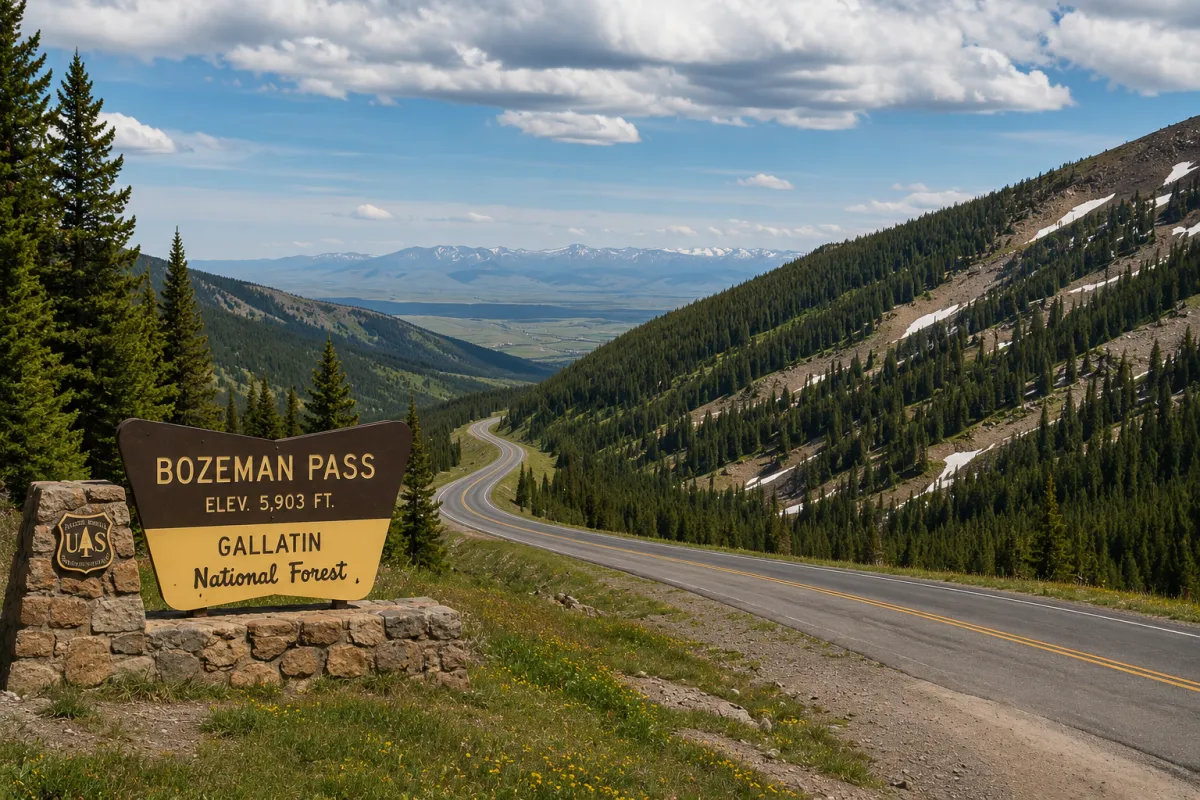
What Is the Bozeman Pass Commute Really Like in 2026?
Twenty-seven miles, one mountain pass, and the number that decides whether the price gap is worth it.
The short answer: Thirty to thirty-five minutes each way in fair weather, and something else entirely from November to March. Roughly 27 miles of Interstate 90 separate Livingston from Bozeman, and about $231,000 separated their June 2026 median sale prices in Big Sky Country MLS data. The drive is straightforward most of the year and genuinely demanding for a stretch of it: Montana Free Press, mapping state crash data, found this section carries an accident rate close to four times the average for Montana interstates, it can close on short notice in winter storms, and it runs through a wildlife corridor that has been studied for two decades. On standard assumptions, driving it five days a week pencils out to roughly $9,850 a year and 240 to 280 hours behind the wheel. Whether that trade works is a math question, and most people never do the math.
Buyers ask this question in July, standing in a Livingston kitchen with the windows open. The honest answer requires picturing February.
How long does the Bozeman Pass commute actually take?
Thirty to thirty-five minutes each way in good conditions, roughly 27 miles from Bozeman's east-side interchanges to Livingston's. The route climbs from the Gallatin Valley over the divide between the Bridger and Gallatin ranges, then drops into the Yellowstone River valley. In winter that same drive runs 45 minutes to an hour, and some mornings it does not run at all.
The pass itself is not a dramatic mountain crossing by Montana standards. There are no switchbacks and no seasonal gate. What it has is elevation and exposure. Montana's Department of Transportation runs a road-weather station at the summit, sited at 5,748 feet at milepost 321.8, with four cameras and sensors reporting pavement temperature, wind gust, and precipitation type. That station exists because conditions at the top routinely differ from conditions at either end.
Here is the drive, milepost by milepost, which is how people who make it daily actually think about it.
| Milepost or exit | What is there | Why a commuter cares |
|---|---|---|
| Exit 313, Bear Canyon | East edge of Bozeman, start of the climb | MDT's six-mile rehabilitation between exits 313 and 319 finishes with final pavement markings in mid-to-late August 2026 |
| Milepost 314 | Railroad underpass with wildlife exclusion fencing | Eight-foot fence along 1.4 miles, installed spring 2007, routes animals under the interstate instead of across it |
| Exit 316, Trail Creek | Mid-climb interchange | Frontage access, and a common spot for conditions to change |
| Exit 319, Jackson Creek | Last interchange before the summit | Where westbound traffic often first sees weather |
| Milepost 321.8 | The summit | MDT road-weather station at 5,748 feet, four live cameras |
| Exits 330 and 337, Livingston | East and west ends of town | The six-mile business-loop detour on Park Street, used when crosswinds move traffic off the interstate |
Two things stand out on that list. The construction is real and nearly over: MDT and Knife River finished chip seal, pavement repair, and signage by July 2026, with only final striping left. And the wind zone is not the pass. It is Livingston.
What makes this stretch of I-90 different from an ordinary commute?
Traffic volume meeting mountain geometry. When Montana Free Press mapped five years of state crash data covering 2019 through 2023, the Bozeman-to-Livingston section stood out as the busiest stretch of rural interstate in Montana, with tight corners and an accident rate close to four times the average for Montana interstates. It was the most crash-prone interstate segment the analysis identified.
That number deserves context rather than alarm. Four times a low base rate is still a low absolute rate, and interstates as a class are Montana's safest roads: the same analysis put the crash index for interstates at 90 against 134 for all highways. The report's authors also noted plainly that the underlying MDT crash data does not let you separate winter storms from animal strikes from impaired driving, so the figure describes where crashes cluster, not why.
What it tells a buyer is simple enough. This is not a rural two-lane where a deer at dusk is the main thing to watch for. It is a busy interstate segment where heavy traffic, weather that changes over several hundred feet of climb, and curves laid out in a different era all occupy the same twenty-seven miles. People who drive it daily adjust their following distance in October and stop trusting the forecast in Bozeman to describe conditions at milepost 321.
What does winter actually do to the drive?
It introduces a category most out-of-state buyers have never planned around: the day the road is simply closed. Montana closes interstates when conditions warrant, and this corridor gets closed. During severe winter storms MDT has shut I-90 in both directions across this stretch and far east of it, sometimes for most of a working day, which is a different problem than a slow drive.
Wind is the other mechanism, and it operates east of the pass rather than on it. MDT maintains a standing I-90 detour through Livingston, roughly six miles on the business loop and Park Street between exits 337 and 330. MDT's own description is that it may determine at any time that certain vehicles, or all traffic, must use the detour, based on crosswinds and adverse weather. If you have spent time in Livingston you already understand why. The wind there is a design constraint, not a weather event, and that piece of local reality is covered more fully in what it is really like living in Livingston and Paradise Valley.
When the pass itself closes, there is no quick way around. The alternate is Bridger Canyon: Montana Highway 86 out of Bozeman, up past Bridger Bowl and over to US 89 north of Wilsall, then south down the Shields Valley into Livingston. It is roughly triple the distance on two-lane roads that are frequently in worse shape than the interstate you left, and it is not a commuting plan. It is a way home.
The practical habit every corridor commuter develops: check 511mt.net before leaving, not after loading the car. MDT posts closures, restrictions, and the summit cameras there, and you can dial 511 inside Montana or 800-226-7623 from out of state. New arrivals learn this in their first winter, along with several other things covered in what surprises people most after their first year in Montana.
How much of a wildlife corridor is this, really?
One of the most thoroughly documented in the state. The Craighead Institute's Bozeman Pass work recorded 2,272 animals representing 49 species of mammals, birds, and reptiles killed on the pass between January 2001 and June 2010, including 947 deer, 305 skunks, 195 raccoons, 50 elk, 25 black bears, 9 moose, and 9 mountain lions. The researchers also noted that visible roadkill represents half or less of the actual toll, since injured animals often leave the roadway before dying.
That decade of counting produced infrastructure rather than just a paper. The Western Transportation Institute at Montana State ran a pilot study from 2003 to 2010 with Craighead, MDT, and Montana Rail Link, testing whether exclusion fencing and cattle guards installed during a 2004 railroad overpass reconstruction near milepost 314 would both reduce collisions and push animals toward the existing structure underneath the interstate. Eight-foot fencing went up along a 1.4-mile section in spring 2007.
For a commuter, the takeaway is not statistical, it is behavioral. Dawn and dusk are the exposure windows, and the winter commute puts you on the pass in the dark at both ends of the day. Comprehensive coverage and a realistic deductible are part of the cost of this drive, and animal strikes are one of the reasons insurance questions come up more often here than buyers expect.
What does the Bozeman Pass commute cost per year?
More than most buyers assume, and less than enough to erase the price gap. Using about 54 miles round trip, 48 working weeks, and the IRS standard rate of 76 cents per mile in effect since July 1, 2026, a five-day-a-week commute models out to roughly $9,850 a year in all-in vehicle cost and 240 to 280 hours behind the wheel, which is six to seven full work weeks.
| Days on site per week | Round trips per year | Miles per year | Vehicle cost at $0.76/mile | Hours driving |
|---|---|---|---|---|
| 5 | 240 | 12,960 | $9,850 | 240 to 280 |
| 4 | 192 | 10,368 | $7,880 | 192 to 224 |
| 3 | 144 | 7,776 | $5,910 | 144 to 168 |
| 2 | 96 | 5,184 | $3,940 | 96 to 112 |
The hour ranges assume 30 to 35 minutes each way in ordinary conditions, which is the fair-weather case. Winter adds to it.
Three clarifications before anyone builds a spreadsheet on this. The IRS rate is a per-mile cost proxy covering fuel, maintenance, tires, and depreciation, and it is used here for exactly that, so your real number moves with your vehicle, your fuel economy, and how hard you are on brakes. Commuting between your home and a regular workplace is not a deductible expense, so nothing in that table is a write-off. And the rate itself moved mid-year: the IRS set 2026's business rate at 72.5 cents in January, then raised it to 76 cents effective July 1 in Announcement 2026-11, citing fuel prices that had climbed roughly 38 percent since January. Mid-year adjustments to that rate are unusual, and they tell you something about the direction of the input costs.
Now put it against the reason people consider the drive at all. In June 2026, Livingston's median sold price was $512,750 across 18 sales, per the Big Sky Country MLS data in the Livingston market report. Bozeman's June 2026 median was $743,592 across 130 sales, per the same source's Bozeman report. That is a gap of about $231,000. Both are single-month snapshots from a small market and will move, so treat them as a reading rather than a fixed benchmark.
At $9,850 a year, the five-day commute takes roughly 23 years to consume that gap. The drive is a real cost and it is not a rounding error, but the arithmetic does not undo the price difference. What it does is convert a housing decision into a lifestyle decision, which is the honest way to frame it. If you want the full price comparison between the two markets, Livingston vs Bozeman: where should you buy in 2026 walks through it, and what $500,000 buys in Park County covers what the Livingston end of that gap actually gets you.
Is there a way to make the trip without driving it yourself?
Seasonally, yes, and most buyers looking at Livingston have never heard of it. Streamline runs a Livingston route Monday through Friday during the winter and spring months, connecting Livingston with stops including the MSU campus, Bozeman Health, and Bozeman's west side. The system is fare-free. The 2026 season's last day was Friday, May 8.
The catch is that it is built around one morning run and one evening run, so it fits a conventional schedule and nothing else. The morning bus leaves Bozeman at 5:50 a.m., reaches Livingston at 6:30, and is back at the MSU student union by 7:20. The evening return leaves Bozeman in the late afternoon. Streamline also states plainly that I-90 closures are outside its control and can stop service, which means the bus is subject to the same February that your car is. Check the current schedule directly before planning around it, since the seasonal dates and times change year to year.
For a person working a fixed shift in Bozeman four or five days a week, it is a genuine option and worth a look before assuming a second vehicle is required. For anyone with variable hours, evening obligations, or kids to collect, it is not a substitute for driving.
So should you buy in Livingston and work in Bozeman?
For most people who ask, yes, with one condition: drive it in the worst month before you commit to it for ten years. The commute is unremarkable for roughly eight months a year and demanding for the other four, and the people who regret it are almost always the ones who evaluated it in July.
What I would actually recommend. Drive the pass on a bad February morning, at the hour you would really be driving it, before you write an offer. Assume five to ten days a winter when the drive is slow, ugly, or off the table entirely, and find out now whether your employer treats those as remote days or as absences, because that single answer changes the math more than anything on this page. Budget the vehicle honestly, including winter tires and the possibility of an animal strike. And if your work is fully remote, recognize that you are buying the Livingston end of a $231,000 gap without paying the commute at all, which is a materially different purchase than the one this post describes.
The people who make this work treat the drive as a known cost rather than a daily surprise. They keep 511 bookmarked, they leave earlier from November through March, and they made peace with the pass before they signed anything. If you are still weighing the two ends of the corridor, what moving to Bozeman actually looks like in 2026 covers the other side of the same decision.
Frequently Asked Questions
How long is the drive from Livingston to Bozeman?
About 27 miles on Interstate 90, typically 30 to 35 minutes each way in fair conditions. Winter routinely stretches that to 45 minutes or an hour, and MDT closes the corridor outright during severe storms. The route crosses Bozeman Pass, where MDT's road-weather station sits at 5,748 feet at milepost 321.8.
Is the Bozeman Pass commute dangerous in winter?
It demands more attention than an ordinary commute. Montana Free Press, mapping MDT crash data from 2019 through 2023, found this section carries an accident rate near four times the average for Montana interstates and is the busiest rural interstate stretch in the state. The data cannot separate weather from other causes, so treat it as a reason to build in margin rather than a verdict.
Does I-90 close between Bozeman and Livingston?
Yes, during winter storms and high wind. MDT has closed both directions across this corridor for most of a working day in severe conditions. MDT also maintains a standing six-mile detour through Livingston between exits 337 and 330 for crosswinds and other hazards. Check 511mt.net or dial 511 in Montana before traveling.
What is the alternate route when Bozeman Pass is closed?
Montana Highway 86 through Bridger Canyon from Bozeman to US 89 north of Wilsall, then south through the Shields Valley to Livingston. It runs roughly triple the distance on two-lane roads that are often in worse condition than the interstate. It is a way home when I-90 is shut, not a commuting alternative.
How much does commuting over Bozeman Pass cost per year?
Roughly $9,850 a year at five days a week, modeled on about 54 miles round trip, 48 working weeks, and the IRS standard rate of 76 cents per mile effective July 1, 2026. That rate is a proxy for fuel, maintenance, and depreciation, so your actual cost varies by vehicle. Commuting to a regular workplace is not tax deductible.
Is there a bus between Livingston and Bozeman?
Streamline operates a fare-free seasonal Livingston route Monday through Friday during winter and spring, with one morning run and one evening run serving stops including the MSU campus and Bozeman Health. The 2026 season ended May 8. Season dates, stops, and times change from year to year and service can be canceled when I-90 closes, so confirm current information with Streamline directly.
How much cheaper is Livingston than Bozeman?
In June 2026, Livingston's median sold price was $512,750 across 18 sales and Bozeman's was $743,592 across 130 sales, both per Big Sky Country MLS data published in local brokerage market reports. That is a gap of roughly $231,000. Small monthly sample sizes move medians around, so read single months as snapshots.
Are there a lot of animal collisions on Bozeman Pass?
Enough to have driven a decade of research and permanent infrastructure. The Craighead Institute recorded 2,272 animals across 49 species killed on the pass between January 2001 and June 2010, including 947 deer and 50 elk, and noted that visible roadkill is half or less of the real toll. Eight-foot exclusion fencing went up along a 1.4-mile section in 2007.
If the commute math works for you, see how I work with buyers.
This article is general information, not legal, tax, or accounting advice. Stacy Bennin is not a law firm or an accounting firm, and nothing here should be treated as advice from one. Laws, tax rules, and programs change, and they vary by state and by situation. Before acting on anything covered here, consult a licensed attorney and/or a certified public accountant in your state for current guidance on your specific circumstances.
Stacy Bennin is a licensed real estate broker in Montana, affiliated with Legacy Lands Real Estate in Paradise Valley. She helps buyers and sellers across Park County and southwest Montana find property that fits their needs, and stays current on AI and emerging technology so her clients benefit from where real estate is headed, not just where it has been. Reach her at stacybennin.com or (406) 224-3267.
Have questions about Montana real estate?
Call or text Stacy at 406-224-3267, email [email protected], or pick a time that works for you.
