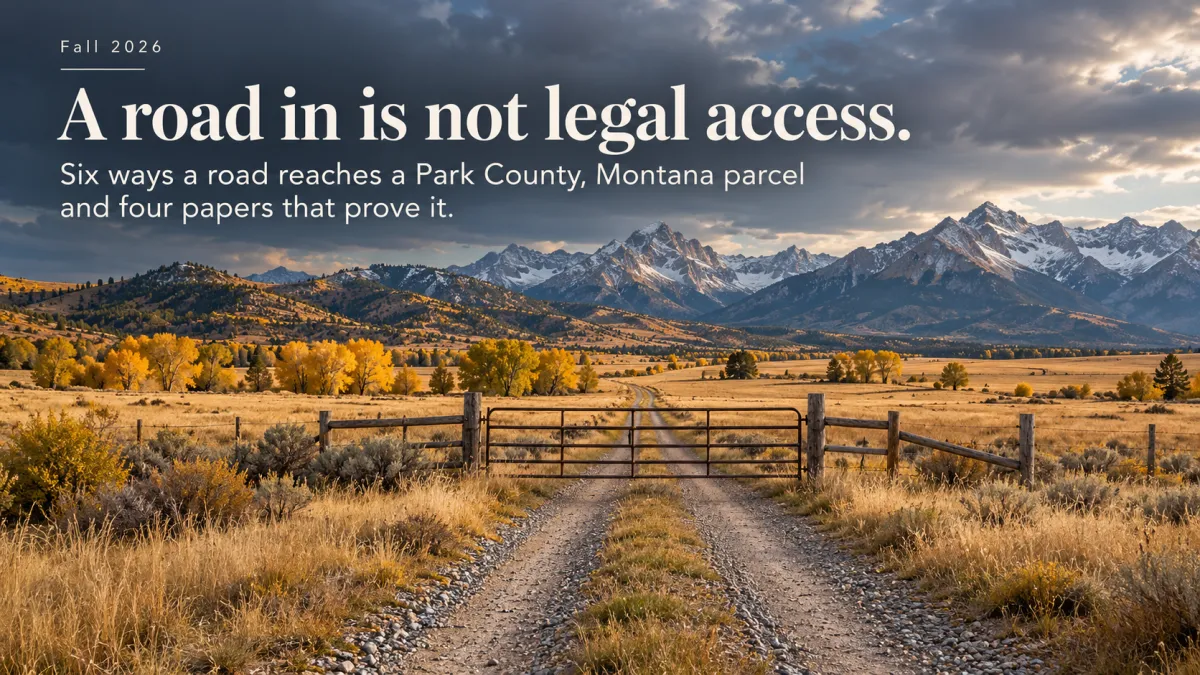
A Road to the Property Is Not Legal Access in Montana
A gravel road can reach a parcel for fifty years and still give the next owner no right to drive it. Here is the difference between a road that exists and access that holds, the six ways a road can reach a Montana property, and the four papers that tell you which one you are buying.
If you are looking at rural property in Park County and the listing says "easy access" or "year-round road," the question to settle before you write an offer is whether the right to use that road comes with the land or depends on someone else's goodwill. This post explains how Montana law separates physical access from legal access, what a recorded easement has to say, what happens when the only access is by use rather than by deed, how lenders and title insurers treat the question, and how to check it yourself before the inspection deadline.
Does a road to the property mean you have legal access in Montana?
No. Physical access is a road you can drive. Legal access is a right, held in a recorded instrument or established by law, to cross other people's land to reach yours. Montana treats a right-of-way as a servitude attached to land under MCA 70-17-101, and a road that nobody granted, dedicated, or established under Montana's prescription or necessity rules is not one. An unconfirmed claim under those rules is not something a title company will insure.
A road can exist for decades on a handshake. The rancher who owned the whole section let the neighbor drive through, the neighbor's buyer kept driving through, and three sales later the listing calls it access. It may be. It may also be informal permission that the current owner of the crossed land can withdraw, or a claimed right that nobody can insure, finance, or enforce until a court agrees after a lawsuit nobody wants to fund.
Two facts make this worth a post. First, the subdivision statute is where Montana requires a finding of legal and physical access, and parcels created by exemption, which include many older rural tracts, did not get that particular review. Second, the standard owner's title policy form insures that some right of access exists, subject to its exceptions and endorsements, but not that the access is the road you were shown, and not that it is passable in February. Both points are developed below.
The position this post takes: read the access paper before the inspection, not after, because a physical inspection cannot find a missing easement, and the fix for a missing one is a negotiation with a neighbor or a lawsuit, neither of which fits inside a contingency period.
What are the six ways a road can reach a Montana parcel?
Six common ones, in rough order of how much a buyer can rely on them: a county or state road, a road dedicated on a recorded plat, a recorded private easement, a public road established by prescription, a private prescriptive easement or easement by necessity that no court has yet confirmed, and plain permission. The first three are documents. The next two can arise by operation of law when the facts qualify, but proving them is another matter: a disputed or unrecorded claim typically needs a court judgment before a title insurer or lender will treat it as access, and how a given insurer or lender handles one is case by case. The last one, unless it is a written license, can end with a conversation.
| How the road reaches the parcel | What proves it | What can end or limit it | How a lender or title company sees it |
|---|---|---|---|
| County road or state highway | The county road book, the county's maintenance list, MDT's system | A county abandonment petition under MCA 7-14-2601 | Public access, no easement needed |
| Road dedicated on a recorded subdivision plat | The plat, filed with the clerk and recorder, and the plat's notation of access under MCA 76-3-608 | Plat amendment or vacation; HOA or road district rules | Legal access shown; maintenance agreement or HOA still checked |
| Recorded private easement | The easement deed or reservation, recorded, with a legal description | Its own terms; merger with the crossed land, destruction of it, or an act by the holder incompatible with the easement, under MCA 70-17-111 | The instrument is what the underwriter reads |
| Public road by prescription | A court judgment, or county recognition after a petition | Litigation over the evidence of public use; disuse for the prescriptive period under MCA 70-17-111 | Treated as public only once established |
| Private prescriptive easement, or easement by necessity | Qualifying use or severance may create it by operation of law; in practice, a court judgment after proof of the elements | Fails if any element is missing; necessity ends when necessity ends | Not insurable or financeable as legal access until adjudicated |
| Permission (a license) | Nothing recorded, or an unrecorded written license | The owner of the crossed land, unless a written agreement or another legal doctrine makes it enforceable | Not legal access |
Source: MCA 70-17-101, 70-17-111, 7-14-2601, 76-3-608; Montana Legislative Services memo on prescriptive easements and ways of necessity; Fannie Mae Selling Guide B4-1.3-04; HUD private roadway guidance.
The county road category is easier to check than most buyers expect and harder than it sounds. Park County's Roads and Bridges department says on its page that it maintains 873 miles of county roads and bridges, and the Park County Road Book, the record of which roads the county holds, is available for public viewing in the Clerk and Recorder's vault at 414 East Callender Street in Livingston. A road can be a county road and still get little or no winter maintenance, because public status and the county's service level are two different questions; the plowing post covers the county's maintenance tiers. A road can also look like a county road, with a green sign and a name, and be private. The sign is for the ambulance, not for title.
County roads can also go away. Under MCA 7-14-2601, any 10, or a majority, of the real property owners of a road district that is taxable for road purposes may petition the county commissioners in writing to establish, alter, or abandon a county road. Abandonment takes notice and a public hearing, and under MCA 7-14-2615 the county may not abandon a road that gives access to private land benefiting two or more landowners unless all of them agree. Abandonments are rare, but a parcel whose only public access is a lightly used county spur still has a different risk profile than one on a numbered route, and the spur's status in the road book is worth confirming.
The plat category applies to lots in subdivisions that went through review. Under MCA 76-3-608(3)(d), one criterion the county reviews is "the provision of legal and physical access to each parcel within the proposed subdivision and the required notation of that access on the applicable plat and any instrument of transfer concerning the parcel." That is the state saying, in statute, that legal and physical access are two different things and both have to be shown on a plat reviewed under current law. The catch is which parcels get that review. MCA 76-3-207 exempts several kinds of land division from subdivision review, including a single gift or sale to a member of the landowner's immediate family and divisions under an agricultural covenant. A fifteen-acre tract split off a ranch for a son in 1988 may have a certificate of survey, a deed, and no access finding from the subdivision process; the law in force at the time and the county's file decide it, and the checking is the buyer's to do.
What does a recorded easement have to say?
Enough to describe the right without a witness. Under MCA 70-17-106, the extent of a servitude is determined by the terms of the grant, or, for one acquired by use, by the nature of the enjoyment that created it. For a clearly written easement, the grant generally defines the right, subject to how a court reads it. What the deed leaves out, you argue about later.
When you read an access easement, look for these, and notice which are missing:
- A legal description of the easement itself, not just of the parcels. A line that says "an easement for access across the grantor's land" with no width, no course, and no exhibit is a lawsuit with a recording number. The best instruments describe a centerline and a width, or attach a survey exhibit, and the land survey post explains how a surveyor locates one on the ground.
- The purpose and scope. Ingress and egress for a single residence is a different right than access for a subdivision, a commercial operation, or utilities. Under 70-17-106 the grant sets the extent, and the statute adds that the holder of a written servitude may not use it to grant additional rights and privileges to a successor or assignee unless the successor or assignee is specifically provided for in writing. An appurtenant easement itself passes with the land; what does not pass is more than the grant gave. If you plan to split the parcel or build a second house, the easement's scope is the first thing to read.
- Whether it runs with the land. An easement that is appurtenant, meaning attached to the parcel, passes to the next owner. A personal right granted to a named individual may not. The instrument's language and the deed chain decide it, and this is one of the places where a title officer or an attorney earns their fee.
- Maintenance. Montana's courts, from Laden v. Atkeson in 1941 through Guthrie v. Hardy, 2001 MT 122, recognize the general rule that the owner of an easement has both the right and the duty to keep it in repair. In Schubert v. Toepp, decided in October 2025, the court affirmed limits on how far that maintenance right reaches onto the crossed land. A well-drafted easement says who maintains, who pays, and how far off the road the work can go, so that nobody has to ask a judge.
- Recording. Under MCA 70-21-304, a conveyance of real property, other than a short lease, is void against a later purchaser or encumbrancer of the same property who takes in good faith and for value and records first. How that plays out for a particular easement is for a Montana attorney to say. An easement that lives in a drawer at the ranch house is weak protection against the neighbor's next buyer, and whether it holds can turn on what that buyer knew or should have seen on the ground. Record it. In Park County, recording runs through the Clerk and Recorder, whose posted notice says that under House Bill 192 the fee for recording a document rose on October 1, 2025, to $20 for the first page and $10 for each additional page, with inflation adjustments starting in July 2027.
An easement can also end. MCA 70-17-111 lists the ways: the easement and the crossed land come into the same hands, the crossed land is destroyed, the easement holder does something incompatible with the easement, or, for a servitude acquired by enjoyment, the holder stops using it for the period the law sets for acquiring one that way. Which of those applies to a given easement depends on how it was created, and that is a question for counsel. The first one matters more than it sounds. If you buy the neighbor's parcel to protect your access and later sell one of the two, the easement that merged into your ownership may not come back on its own.
What happens when the only access is by use, not by deed?
Then the access is a claim. Montana law recognizes prescriptive easements and easements by necessity, and a qualifying use or severance can create one by operation of law, but until a court adjudicates it nobody can prove it to a title insurer, a lender, or a disputing neighbor. Each has elements that must all be proved, the burden is on the party claiming the right, and the courts have said in so many words that they view implied easements with extreme caution.
The Montana Legislative Services memo on prescriptive easements and ways of necessity, prepared by Legal Services Director Gregory Petesch for an interim committee, dates from about 2000 and is still a clear summary of the foundational cases in one place. It is legislative staff background rather than law itself, it cites the Montana Supreme Court decisions by name, and later decisions such as Frame v. Huber in 2010 restate the same elements. It lays out the three routes:
| Route to access by use or implication | What has to be proved | Where the burden sits |
|---|---|---|
| Prescriptive easement (private or public) | Open, notorious, exclusive, adverse, and continuous use for the statutory period of 5 years; for a public road, a definite fixed course used by the public under a claim of right | On the claimant, every element, by clear and convincing evidence; once use for the period is shown, adversity is presumed and the landowner must prove permission; tax payment not required |
| Easement by implication from prior use | Separation of title; a long-standing, obvious use before separation showing the use was meant to be permanent; necessity for beneficial enjoyment | On the claimant; considered with extreme caution |
| Easement by necessity | Unity of ownership of both parcels at severance, and strict necessity existing at severance; never across a third party's land | On the claimant, by clear and convincing evidence |
Source: Montana Legislative Services Division memo (Petesch), citing Shors v. Branch, Tanner v. Dream Island, Graham v. Mack, Schmid v. McDowell and others; Frame v. Huber (Mont. 2010).
A few things in that table decide real transactions.
Five years is the period, and it has to be adverse. The memo, citing Shors v. Branch and Tanner v. Dream Island, states that prescriptive easement actions require proof of open, notorious, exclusive, adverse, and continuous use for five years, that the burden is on the party seeking the easement to prove all of it, and, after Wareing v. Schreckendgust, by clear and convincing evidence. It also notes the other half of the rule: once a claimant shows the use for the period, a presumption of adverse use arises and the burden shifts to the landowner to prove the use was permissive. That is why a landowner who wants to keep a road private keeps a written record of the permission. Adverse means without permission. A road used with the owner's blessing for thirty years may never ripen into a prescriptive right, because permission defeats the claim. That is the trap in the friendly-rancher story above: the friendlier the history, the weaker the prescriptive case.
Necessity has to date from the split. In Frame v. Huber, the Montana Supreme Court restated the two elements of an easement by necessity, unity of ownership and strict necessity, with the necessity existing both when the parcel was split and when the claim is made, and said such easements are considered with extreme caution because they deprive an owner of property rights through mere implication, so a claimant must prove the elements by clear and convincing evidence. The memo adds the practical limit from Schmid v. McDowell: the way must run over land the same grantor kept or conveyed, never over a stranger's land. If the parcel was landlocked when it was split off and the only route runs across the seller's other land, the claim may exist. If the route runs across a third party's land, or the parcel had access at the split and lost it later, the doctrine does not reach. Montana does give a landlocked owner one more door: under MCA 70-30-107, a private road may be opened by condemnation, with a jury first deciding the necessity of the road and the damages, and the benefited owner paying both the damages and the costs of the proceeding. It is a lawsuit with a price tag, not a right that comes with the deed.
Public roads by prescription are real, and they are litigated. The memo describes the standard from Descheemaeker v. Anderson: the public has to have followed a definite fixed course, continuously and uninterruptedly, with an assumption of control under a claim of right for the statutory period. Adverse use combined with the county grading and maintaining a road without the landowner's permission has been enough. This category produces a steady share of Montana access litigation, and it is also why an old county-graded road that is not in the road book is neither clearly public nor clearly private.
What this means for a buyer is simple to state and hard to hear: if the only access is one of these, you are not buying proven access, you are buying a claim and the cost of proving it. Some buyers do that with open eyes, price it in, and hire counsel before closing. Nobody should do it by accident.
How do lenders and title insurers treat access?
As a document question. Fannie Mae and FHA both start from a recorded right, and a standard owner's title policy insures that a right of access exists, not that the access is the road you drove in on.
Fannie Mae. For loans sold to Fannie Mae, the Selling Guide's site section, in the version live as of September 2026 and last updated June 4, 2025, says that if the property is on a community-owned or privately owned and maintained street, an adequate, legally enforceable agreement or covenant for maintenance of the street is required, recorded in the land records, with three things in it: responsibility for payment of repairs including each party's share, default remedies if a party does not comply, and an effective term that in most cases should be perpetual and binding on future owners. If there is no adequate agreement and the state has no statute defining owner maintenance responsibilities, the lender may still sell the loan but has to indemnify Fannie Mae against losses from the street's condition or from establishing or keeping access. In practice, that indemnity is why some lenders will not close on a shared road without the agreement.
FHA. HUD's Handbook 4000.1 requires access from a public street or a private street protected by a permanent recorded easement, an ownership interest in the road, or ownership and maintenance by a homeowners association, applies the same requirement to shared driveways outside an HOA, and asks the appraiser whether a maintenance agreement exists without requiring one. HUD's older private roadway reference page, archived in 2012, said the same thing more bluntly: evidence of a road maintenance agreement is not required. Recorded easement yes, maintenance agreement no: a different emphasis than Fannie Mae's, and a reason the same shared driveway can be fine for one loan and a problem for another. The lender's underwriter applies the current version of whichever rule governs the loan.
Title insurance. Covered Risk 4 in the ALTA owner's policy form (ALTA's public copy is its 2021 form marked up against the 2006 one), the version Montana title insurers issue on, insures against "no right of access to and from the Land," subject to the policy's exclusions, Schedule B exceptions, and endorsements. Read that narrowly, because the insurer does. It is a promise that some legal right of access exists. It is not a promise that the access is by the road in the listing photos, that it is wide enough for a moving truck, or that it is passable in winter. Title commitments also commonly carry exceptions for matters a survey would show and for easements not of record, which is exactly where unrecorded use lives. Ask your title officer what the commitment says about access, in plain words, and whether an access endorsement is available for the parcel; the answer varies by insurer and by file.
The lender rules also give you a free checklist. Fannie Mae's three provisions, who pays and in what share, what happens on default, and how long it lasts, are the three questions to ask about any shared road, whether or not you are borrowing.
What about a shared driveway?
A shared driveway is an easement with neighbors attached, and it needs the same paper as any other easement plus an agreement about money. The two instruments to look for are the recorded easement that creates the right to use the drive and a recorded maintenance agreement that says who plows, who grades, who pays, and what happens when someone does not.
The easement instrument answers the questions in the section above: where the drive runs, how wide, for what use, and whether it runs with the land. The maintenance agreement answers the ones that turn neighbors into litigants. Without one, the default rule from Guthrie is that the easement holders have the right and the duty to maintain, which tells you who can fix the road but not how the bill splits among four households; absent an agreement, that split is a question for the instruments and, failing those, for counsel. The plowing post covers what that looks like in January.
Three situations come up over and over on Park County showings:
- The driveway crosses the seller's other land. The seller is keeping the parcel next door and selling you the one behind it. Your access has to be reserved or granted in a recorded instrument at or before closing, with a legal description, or you are relying on an easement by necessity claim against the person you just paid. Ask that the easement be drafted and recorded as part of the transaction, not promised for later.
- The driveway was built by a prior owner across a neighbor with no paper. This is the permission case. The current neighbor may be friendly. The neighbor's estate, or their buyer, is a stranger. The clean fix is a recorded easement, which the neighbor can price or refuse. Whether the seller can deliver it is a closing question, and your attorney can write the offer to require it.
- Several parcels share one drive and one of them is the seller's. Ask for the maintenance agreement. If there is none, ask the seller who paid for the last grading and the last plow season, in writing. A shared road with a history of one household paying for everyone is a road with a dispute in it.
For any of the three, the do-this-week action is the same: get the recorded instrument number for the access easement from the title commitment and read the instrument itself, not the commitment's one-line summary of it.
How do you run the four-paper check before the inspection deadline?
Pull four papers, in this order, and read them against each other. This is the four-paper check, and it takes an afternoon plus one conversation with a title officer.
| Paper | Where to get it | What it answers |
|---|---|---|
| Title commitment, Schedule B | Your title company, usually within days of the accepted offer | Which recorded easements and agreements affect the parcel, by instrument number, and which standard exceptions the insurer is taking |
| The access instruments themselves | Park County Clerk and Recorder, online through iDoc Market for documents recorded since March 1972 | The width, course, purpose, maintenance terms, and whether the right runs with the land |
| The plat or certificate of survey | Clerk and Recorder; the parcel's legal description names it | Whether the parcel went through subdivision review with an access finding, or was created by exemption |
| The county road book and the cadastral map | Road book in the Clerk and Recorder's vault; Montana Cadastral online | Whether the road is a county road, and whose land the road crosses between the highway and the gate |
Source: Park County Clerk and Recorder; Park County Roads and Bridges; Montana State Library Cadastral.
Step one, Schedule B. Every recorded easement the title company found is listed here with an instrument number. If the schedule shows no access easement and the parcel does not touch a public road, stop and ask why. If it shows one, note the number.
Step two, the instrument. Park County's iDoc Market holds documents recorded since March 13, 1972, searchable by instrument number, party name, and legal description; documents from the late 1800s through March 12, 1972 are online through the county's ArcaSearch index, and the office at 414 East Callender holds the originals. Read the easement's own words against the checklist in the section above. If the description is vague, ask the title officer whether the insurer will insure access over it as written.
Step three, the plat or survey. The legal description on the deed names a subdivision and lot, or a certificate of survey number, or a metes-and-bounds tract. A subdivision plat approved since the access criterion entered the statute (it is in the 1999 code) should carry the notation 76-3-608 requires, though older plats, amendments, and the approval file need to be checked with the county. A certificate of survey from an exemption means the subdivision process did not require anyone to find access. Neither is disqualifying; both tell you how much of the work is yours.
Step four, the road and the map. The Montana Cadastral map, a parcel reference tool rather than a title record, shows parcels and their listed owners, so you can trace the road from the nearest public road to the gate and list every parcel it crosses. Each of those parcels needs to appear in an access instrument, or be public right-of-way, or the chain has a gap. Then confirm the public portion against the county road book. The road book is in the vault, not online; the Roads and Bridges shop at 406-222-4137 can tell you whether a named road is on the county's list.
When the four papers agree, the file is in shape for the title insurer and the lender to confirm, and the access is the kind the next buyer can rely on too. When they do not, you have found the problem while it is still the seller's, and the choices are the ones that exist at every stage of a purchase: fix it as a condition of closing, price it, or walk. The buying land in Montana post covers the rest of the land due-diligence list, and the out-of-state mistakes post covers what happens when the list gets skipped.
The tradeoff to name plainly: parcels with clean, recorded, insured access on a county road cost more than parcels with a road and a story, and the price gap is the market's estimate of the lawyer, the neighbor, and the uncertainty. Sometimes the gap is bigger than the problem, and a buyer who does the four-paper check and hires counsel can buy well. But the check comes first, because the story is free and the easement is not.
Frequently Asked Questions
What is the difference between legal access and physical access in Montana?
Physical access is a road you can drive to the property. Legal access is a right to cross other land to reach it, held in a recorded instrument, dedicated on a plat, established as a public road, or confirmed by a court. Montana's subdivision statute, MCA 76-3-608, names legal and physical access as separate things a county must find before approving a subdivision, and parcels created by exemption from that review may never have had either one checked.
How do I find out if a road to a Montana property is a county road?
Check the county's road book, which in Park County is available for public viewing in the Clerk and Recorder's vault at 414 East Callender Street in Livingston, and call the county road department, which in Park County maintains 873 miles of county roads and bridges. A road sign or a road name does not make a road public. County roads can also be established, altered, or abandoned by petition under MCA 7-14-2601.
How long does it take to get a prescriptive easement in Montana?
Five years of open, notorious, exclusive, adverse, and continuous use, according to the Montana Legislative Services memo summarizing Montana Supreme Court decisions including Shors v. Branch and Tanner v. Dream Island. The burden is on the party claiming the easement to prove every element, permission from the landowner defeats the claim, and the right is confirmed only by a court judgment. Paying taxes on the crossed land is not required for a prescriptive easement.
Can a landlocked parcel in Montana get an easement by necessity?
Only if it meets the elements. The Montana Supreme Court in Frame v. Huber restated the two requirements, unity of ownership of both parcels at the time the landlocked tract was severed and strict necessity existing at that time, and said the claimant must prove them by clear and convincing evidence because such easements are considered with extreme caution. Under that doctrine the way can run only over land the same grantor kept or conveyed, never over a third party's land.
Does a title insurance policy guarantee access to the property?
Not in the way most buyers assume. Covered Risk 4 of the ALTA owner's policy insures against no right of access to and from the land, meaning some legal right of access exists. It does not insure that the access is the road shown in the listing, that it is a particular width, or that it is passable in winter. Title commitments also commonly except matters a survey would disclose and easements not of record. Ask the title officer what the commitment says about access and whether an access endorsement is available.
Do lenders require a road maintenance agreement for a shared driveway in Montana?
It depends on the loan. Fannie Mae's Selling Guide requires an adequate, legally enforceable, recorded agreement or covenant for maintenance of a community-owned or privately owned street, with each party's share of repair costs, default remedies, and a term that in most cases is perpetual, unless state law assigns those duties; without one the lender must indemnify Fannie Mae. FHA's Handbook 4000.1 requires a permanent recorded easement, an ownership interest in the road, or HOA ownership and maintenance, and asks the appraiser whether a maintenance agreement exists without requiring one.
What should a recorded access easement include?
A legal description of the easement itself, such as a centerline and width or a survey exhibit; the purpose and scope, such as ingress and egress for a single residence; language showing it runs with the land to future owners; and maintenance terms saying who repairs, who pays, and how far onto the crossed land the work can go. Under MCA 70-17-106 the extent of a servitude is determined by the terms of the grant, and under MCA 70-21-304 an unrecorded conveyance is void against a later good-faith purchaser who records first.
This article is general information, not legal, tax, or accounting advice. Stacy Bennin Real Estate is not a law firm or an accounting firm, and nothing here should be treated as advice from one. Laws, tax rules, and programs change, and they vary by state and by situation. Before acting on anything covered here, consult a licensed attorney and/or a certified public accountant in your state for current guidance on your specific circumstances.
A road and a right are two different purchases, and the second one is the one that holds. If you are looking at a Park County property that comes with a road and a story, please reach out. The four-paper check is an afternoon of reading and one call to a title officer, and it is much easier to do while the problem still belongs to the seller.
Stacy Bennin is a licensed real estate broker in Montana, affiliated with Legacy Lands Real Estate in Paradise Valley. She helps buyers and sellers across Park County and southwest Montana find property that fits their needs, and stays current on AI and emerging technology so her clients benefit from where real estate is headed, not just where it has been. Reach her at stacybennin.com or (406) 224-3267.
