Why Are More Buyers Looking at Belgrade and Manhattan Instead of Bozeman?
The price gap is real, but the town everyone assumes is the bargain is not the bargain. Here are the July 2026 numbers, and how to shop the corridor without fooling yourself.
Bozeman's median sold price in July 2026 was $753,500. Belgrade's was $599,900. If you are shopping the Gallatin Valley and wondering whether the towns down I-90 are the smarter buy, that gap of roughly $153,600 is the short answer. The longer answer includes a number that surprises most buyers: Manhattan's.
Short answer: Buyers are looking west of Bozeman mainly because of price, and secondarily because growth, new construction, and the airport have all shifted down the interstate. Belgrade genuinely costs less than Bozeman, about $153,600 less at the July 2026 medians. Manhattan is a different story: its July median was higher than Bozeman's, on three sales. The corridor rewards buyers who compare sold data across all three towns instead of trusting one month's headline number in any of them.
What Is Actually Pulling Buyers West of Bozeman?
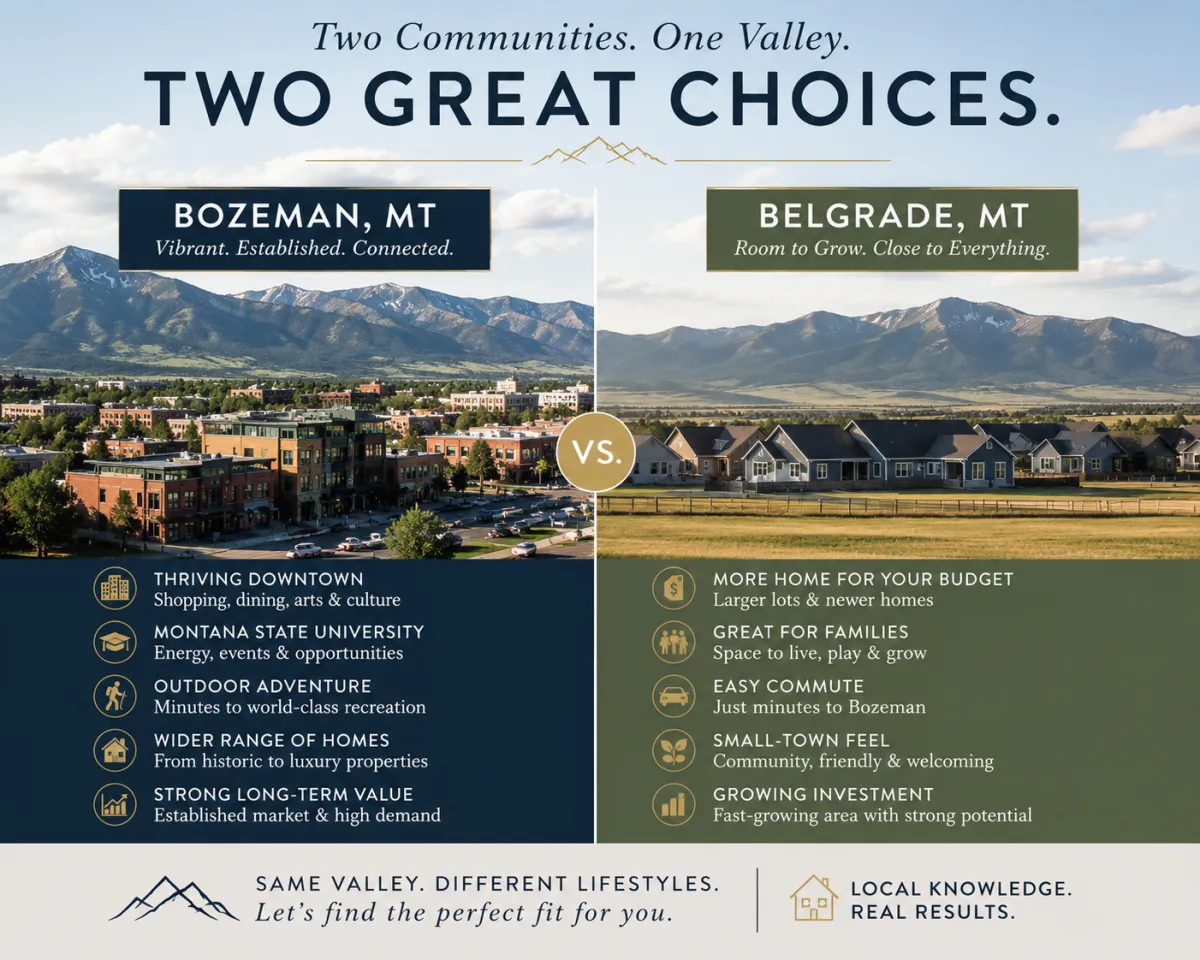
Price is the engine, and everything else rides on it. At the July 2026 medians, the same budget that gets you a median home in Belgrade leaves you about $153,600 short of a median home in Bozeman, per Big Sky Country MLS data for Bozeman and Belgrade. But the westward drift is not just arithmetic. The valley itself has been moving that direction.
Belgrade has grown nearly 23 percent since 2020, adding 312 residents between mid-2024 and mid-2025 after adding 284 the year before, according to Census estimates reported by Montana Free Press in June 2026. Bozeman, for comparison, added 689 residents in 2025 at a 1.2 percent annual rate. Belgrade is smaller, so similar headcounts mean faster proportional change. On the ground, that looks like new rooftops and subdivisions filling in the fields along Jackrabbit Lane.
Then there is the detail out-of-state buyers consistently get backwards: the airport is not in Bozeman. Bozeman Yellowstone International Airport sits in Belgrade, and it handled a record 2,809,419 passengers in 2025, up 6.3 percent from 2,642,707 in 2024. If your life involves regular flights, the "cheaper" town is also the one closer to your gate. Buyers who commute by airplane more often than by car notice this quickly.
None of this is a secret anymore, which is exactly why it shows up in the sold data. Belgrade recorded 43 closed sales in July 2026, up 43 percent from 30 in July 2025. Demand followed the price gap west, the way it has been following affordability out of Bozeman in every direction, a pattern that also shows up over the hill in Livingston.
How Much Less Does a Home Cost in Belgrade Than in Bozeman?
About $153,600 at the median, as of July 2026. Belgrade's median sold price was $599,900 against Bozeman's $753,500, both per Big Sky Country MLS data. That is a 20 percent discount on the median home. But the two markets are moving in opposite directions, and the direction of travel matters as much as the gap.
Here is the corridor side by side:
| July 2026 (Big Sky Country MLS) | Bozeman | Belgrade | Manhattan |
|---|---|---|---|
| Median sold price | $753,500 | $599,900 | $820,000 |
| Change vs July 2025 | down 12.7% | up 11.3% | down 7.8% |
| Closed sales | 133 | 43 | 3 |
| Days to contract | 38 | 31 | 20 |
| Percent of list price | 97.3% | 98.1% | 98.2% |
Read the second row carefully. Bozeman's median fell 12.7 percent year over year while Belgrade's rose 11.3 percent. The discount is real today, and it was bigger a year ago. If both trends held, the gap would keep narrowing. Nobody can promise those trends hold, and single-month medians bounce, but the sold data says Belgrade is no longer the overlooked option. It is the discovered option.
The other rows tell the same story from different angles. Belgrade homes went under contract in 31 days versus Bozeman's 38, and Belgrade sellers captured 98.1 percent of asking against Bozeman's 97.3 percent. In July, 76 of Bozeman's 133 sales closed under asking price. Bozeman buyers are negotiating harder and winning more often. Belgrade sellers are still mostly getting their number. That is what a market that found its moment looks like.
For what those Bozeman dollars actually buy, and what the move itself involves, the full picture is in what moving to Bozeman actually looks like in 2026.
Is Manhattan Actually the Cheaper Option?
Not on the current numbers, and this is where most corridor shopping goes wrong. Manhattan's July 2026 median sold price was $820,000, higher than Bozeman's. Before you cross Manhattan off the list or conclude it has gone expensive, look at the sample size: that median came from three closed sales.
Three sales cannot describe a market. If two higher-end properties and one modest home happen to close in the same month, the median lands wherever the middle transaction sits, and next month it can land $200,000 away. Manhattan sold 3 homes in July 2026, down from 7 the July before. A town of about two thousand people, which is what Manhattan was at the 2020 census, simply does not generate enough transactions for monthly statistics to mean much. The same MLS report calls the market mostly neutral and recently leaning toward buyers, which tells you the $820,000 figure is not evidence of a hot market. It is evidence of a thin one.
So what is Manhattan's actual appeal, if not a discount you can point to on a chart? Scale and position. Manhattan is a small incorporated town on the interstate, with its own school district and main street, surrounded by working farmland in the middle of the Gallatin Valley. Buyers who want a town measured in blocks rather than square miles, with Bozeman reachable in under half an hour, are the ones who ask about it. The tradeoff is patience: with a handful of listings at any given time, you are waiting for the right property rather than choosing among ten of them.
The honest way to price Manhattan is to ignore the monthly median entirely and pull every closed sale from the last 90 to 180 days, then compare price per square foot against similar Belgrade and Bozeman properties. Some months that exercise shows a meaningful discount. Some months it does not. Anyone who quotes you "the Manhattan median" without mentioning the sale count is reading a headline, not a market.
What Do You Give Up by Buying West of Bozeman?
Mostly proximity, and lately, some of the discount. The honest ledger has entries on both sides, and if a broker only reads you one side, get a second broker.
The first entry is the drive. Belgrade sits about ten miles from downtown Bozeman, Manhattan about twenty, and both rides happen on I-90 and the frontage roads rather than over a mountain pass, which makes them gentler than the eastern approach from Livingston that crosses Bozeman Pass. Gentler is not free. If your work and your regular appointments sit in Bozeman, you are buying that drive at rush hour, twice a day, and the Jackrabbit Lane interchange at 5:15 pm is not the empty two-lane it was a decade ago. Drive your actual commute at your actual times before you write an offer. Most of what my clients still drive into Bozeman for, work, medical care, the university, sits east of the interchange; the airport is the notable exception in Belgrade's favor.
The second entry is momentum. The 20 percent discount comes with an 11.3 percent year-over-year price increase attached. You are not early to Belgrade. Buyers betting on a widening bargain are betting against the last year of sold data.
The third is selection at the ends of the corridor. Bozeman closed 133 sales in July against Belgrade's 43 and Manhattan's 3. More transactions mean more choices in any given month, in every price band and property type. In Manhattan especially, the property you want may simply not exist on the market this season.
How Do Property Taxes Compare Across the Valley?
The rate structure is identical in all three towns, because Montana sets it at the state level. For 2026, a qualifying primary residence (or a long-term rental meeting the state's requirements) pays graduated rates published by the Montana Department of Revenue: 0.76 percent on the first $378,000 of market value, 0.90 percent up to $756,000, 1.10 percent up to $1,511,999, and 1.90 percent above that. Second homes, short-term rentals, and vacant residential lots pay a flat 1.90 percent regardless of value.
Two things actually vary with your address. First, mill levies: the rates above produce taxable value, and your bill is that taxable value multiplied by the levies of your specific school district, city or town, and county services, which differ across the valley and change year to year. Second, assessed values, which track what properties in your area are worth. So the tax question between Bozeman, Belgrade, and Manhattan is not "which town has the better rate," because none does. It is "what will this parcel's assessed value and this district's levies produce," and the county treasurer can show you the current bill on any parcel before you offer. The bigger lever by far is whether you qualify for the graduated primary-residence rates at all; the mechanics, deadlines, and the second-home distinction are covered in what you should know about Montana property taxes before you buy.
How Should You Shop This Corridor Without Fooling Yourself?
Treat the corridor as one market, and judge it on sold data. Buyers who lock onto a single town's headline median make worse decisions than buyers who compare actual closings across the valley floor. Three steps, all doable this week with a standard search portal and one phone call:
Draw one search area, not three. Set a single search that covers Bozeman's west side, Belgrade, Manhattan, and the unincorporated land between them. The valley does not stop at city limits, and some of the most interesting properties sit outside all three towns.
Filter to sold listings from the last 90 days first, active listings second. Asking prices are opinions. Closed prices are facts. Ninety days across the corridor gives you enough transactions to see real patterns, which one month in one small town never will.
Compare price per square foot on comparable properties, then drive your commute at 7:45 on a weekday morning. The spreadsheet tells you what the discount is. The drive tells you what it costs. You need both numbers before either means anything.
The reason this works is denominators. Bozeman's median rests on 133 July sales, Manhattan's on 3. Pooling the corridor's closings over a full quarter gives every comparison a base large enough to trust, and it exposes the properties that are mispriced against their neighbors ten minutes away, which is where the actual opportunities live. This is the same discipline that applies anywhere in the region, including for out-of-state buyers starting a Montana search from a distance.
Frequently Asked Questions
How much cheaper is Belgrade than Bozeman right now?
In July 2026, Belgrade's median sold price was $599,900 against Bozeman's $753,500, a gap of about $153,600, according to Big Sky Country MLS data. The gap is real but moving: Belgrade's median rose 11.3 percent year over year while Bozeman's fell 12.7 percent, so the discount was larger a year ago.
Is Manhattan cheaper than Bozeman?
Not on July 2026 numbers. Manhattan's median sold price was $820,000, above Bozeman's $753,500. That median came from three closed sales, which is too few to describe a market. Judge Manhattan on 90 to 180 days of sold listings and price per square foot, never on one month's median.
How far are Belgrade and Manhattan from Bozeman?
Belgrade sits about ten miles from downtown Bozeman along I-90, and Manhattan is roughly ten miles further west. Both are valley-floor interstate drives rather than mountain crossings, unlike the commute from Livingston over Bozeman Pass. Traffic at the Jackrabbit Lane interchange is the main variable at peak hours.
Is Belgrade still growing?
Yes. Census estimates reported by Montana Free Press show Belgrade added 312 residents between mid-2024 and mid-2025, after adding 284 the year before, and it has grown nearly 23 percent since 2020. Growth has cooled from its pandemic-era pace but it has not stopped.
Do Belgrade and Manhattan have the same property tax rates as Bozeman?
The state rate structure is identical everywhere in Montana: graduated 2026 rates for qualifying primary residences and a flat 1.90 percent for second homes and short-term rentals. What differs by address is the assessed value and the local mill levies, which convert taxable value into your actual bill.
Is the Belgrade market cooling like Bozeman's?
Not in the July 2026 sold data. Belgrade's median rose 11.3 percent year over year while Bozeman's fell 12.7 percent, Belgrade homes went under contract in 31 days versus Bozeman's 38, and Belgrade sellers captured 98.1 percent of list price against Bozeman's 97.3 percent.
How many homes actually sell in Manhattan each month?
Very few. July 2026 saw three closed sales in Manhattan, down from seven the July before, per Big Sky Country MLS data. Thin volume defines the market: the right listing can take months to appear, and monthly statistics swing widely on a handful of closings.
Should you search the whole corridor instead of one town?
Yes, if your real constraint is commute time rather than a specific address. Set one search across Bozeman, Belgrade, Manhattan, and the unincorporated land between them, then compare sold prices per square foot over the last 90 days. Shopping the corridor as one market shows you where the value actually sits.
This article is general information, not legal, tax, or accounting advice. Stacy Bennin Real Estate is not a law firm or an accounting firm, and nothing here should be treated as advice from one. Laws, tax rules, and programs change, and they vary by state and by situation. Before acting on anything covered here, consult a licensed attorney and/or a certified public accountant in your state for current guidance on your specific circumstances.
Weighing Bozeman against the towns down the interstate, or trying to make sense of a market where one town's median rose while its neighbor's fell? That is a sold-data conversation, and it goes faster with someone who watches these closings every week. Reach out and we will pull the corridor's actual numbers for your budget.
Stacy Bennin is a licensed real estate broker in Montana, affiliated with Legacy Lands Real Estate in Paradise Valley. She helps buyers and sellers across Park County and southwest Montana find property that fits their needs, and stays current on AI and emerging technology so her clients benefit from where real estate is headed, not just where it has been. Reach her at stacybennin.com or (406) 224-3267.
