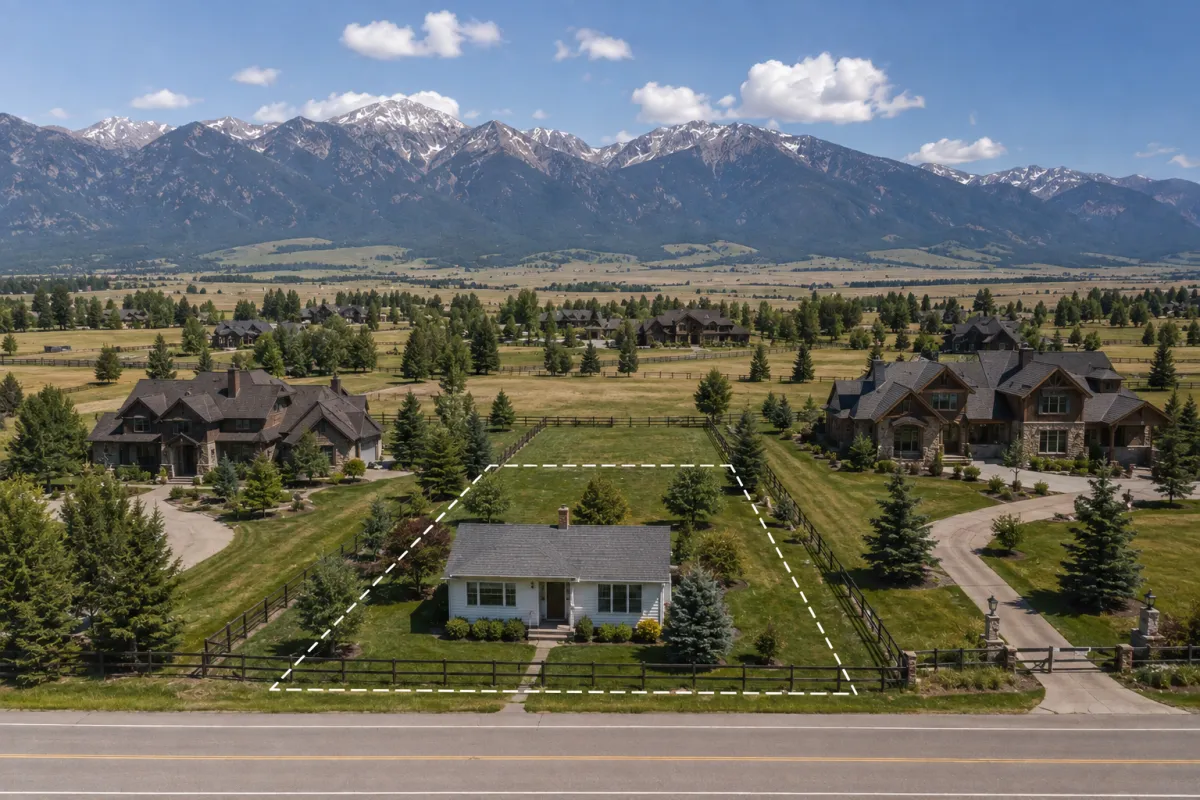
What Does $750,000 to $1 Million Look Like Along the Yellowstone Corridor?
The band above Livingston's median and at Paradise Valley's doorstep is its own market. Here is what it actually buys, town by town.
The short answer: Between $750,000 and $1 million, you are shopping above Livingston's median and right at Paradise Valley's practical entry point. In town, the budget buys the upper tier: character homes, newer construction, or small acreage on the edges. In the valley, it buys the doorstep: the occasional acreage outlier, land worth building on, or patience. In the Shields Valley it stretches furthest. And in 2026, Montana's new tiered property tax treats this exact price band differently depending on whether you live in the home, which changes the real monthly cost more than most listings let on.
This post is the second half of a pair. The first covered what $500,000 buys in Park County, and the short version was: an in-town Livingston budget. Add $250,000 to $500,000 and the map opens up, but not the way most out-of-state buyers expect. Here is where the money actually goes, with numbers from this summer's market, not last year's headlines.
| Corridor segment | What $750K-$1M buys | The honest catch |
|---|---|---|
| Livingston, in town | The upper tier: restored character homes, newer builds, top-of-market finishes | You are paying a premium over a median that sits far below your budget |
| Livingston edges | Newer homes on small acreage, shop space, mountain views | Wind is real, and county services thin out fast |
| Paradise Valley | The entry point: modest homes on acreage, or strong land parcels | Most valley inventory starts near $1 million and climbs from there |
| Shields Valley (Clyde Park, Wilsall) | The most land for the money, home plus acreage within reach | Longer winters, longer drives, thinner services |
| Gardiner | Park-gateway homes, occasionally with short-term rental history | Tiny inventory, tourism-shaped economy, far from everything but Yellowstone |
Where does this budget actually land in the corridor?
In the gap between the town market and the valley market, which is exactly what makes it interesting. Livingston's median sold price was $512,750 in June 2026 per a Big Sky Country MLS market report published by a local brokerage, so $750,000-plus clears the middle of town comfortably. In a market this size the median moves month to month; treat it as a recent snapshot, not a fixed benchmark. Paradise Valley's practical floor sits near $1 million. This band shops the top of one market and the bottom door of another.
That in-between position is worth understanding before you tour anything. Buyers at $500,000 compete in Livingston's core inventory. Buyers at $1.5 million shop Paradise Valley proper. At $750,000 to $1 million you get to choose which game to play: the best house in town, or the least expensive path into the valley. They are genuinely different purchases, different lifestyles, and different maintenance realities, and the right answer depends on how you actually plan to live here, not on which listing photographs better.
One broad pattern colors everything below: Livingston and much of the corridor look like a negotiating market right now. Per the Big Sky Country MLS data for Livingston in June 2026, 18 homes sold, they averaged 36 days on market against 13 a year earlier, and they closed at 94.9 percent of asking, with 11 of the 18 selling under list. Small months swing hard in a market this size, so treat any single month as a snapshot. But the direction is plain: sellers are meeting buyers partway again.
What does the budget buy in Livingston?
The best of town, plainly. With the June 2026 median at $512,750, a $750,000-to-$1 million budget in Livingston is shopping the top tier: restored historic homes near downtown, newer construction with real square footage, or homes on the edges of town with a shop and a view. This is where the budget buys finish quality instead of acreage.
Livingston rewards this band in a way the bigger markets up the road don't. The same money in Bozeman is shopping the middle of the market; we ran that comparison in Livingston vs Bozeman: Where Should You Buy in 2026? and the gap has not closed. In Livingston it buys a house people slow down to look at.
Two honest notes. First, the premium-over-median math cuts both ways: when you buy the most expensive house on the block, the block's median is your resale gravity. Plan to hold, or buy the segment where your price is normal. Second, the wind. Livingston's wind is not a personality quirk, it's a structural consideration: it finds every loose piece of flashing and tests every fence. Locals price it in. Newcomers learn to. The broader picture of life here is in What It's Really Like Living in Livingston and Paradise Valley.
What does it buy in Paradise Valley?
The doorstep, and occasionally the door. At the time of writing in late July 2026, most Paradise Valley listings between Livingston and Gardiner start around $995,000 and run well past $1.5 million, with the typical entry offering being a modest home on three to twenty-five acres around Emigrant and Pray. Below that line, inventory is scarce and moves on its own schedule.
Outliers do surface. This summer's example was a 19-acre property near Emigrant listed around $790,000, which is the kind of listing that proves the exception: acreage in the valley under $800,000 exists occasionally, usually with a compromise attached, whether that's the home's condition, the specific location, or access. When one appears in your band, it deserves a same-week look, because the buyers watching the valley outnumber the listings serving them.
The other honest path at this budget is land now, house later. Strong parcels come up in and around the valley under $1 million, and for some buyers, owning the right ground and building in phases beats stretching for an existing home that isn't quite right. That math has its own traps (site development, well, septic, access, and a building season that does not negotiate), so walk it with people who have done it here.
What this budget generally does not buy in Paradise Valley is the postcard: river frontage, big irrigated acreage, or the bench parcels with full Absaroka views. Those typically trade well above this band, and the rare exception under it usually carries a heavy compromise. Knowing that before you start saves a summer of disappointment tours.
What about the Shields Valley and Gardiner?
The Shields is where this budget stretches furthest. North and east of Livingston, around Clyde Park and Wilsall, $750,000 to $1 million shops home-plus-acreage combinations that the Yellowstone corridor proper stopped offering years ago, and serious land: recent examples at the time of writing included a 160-acre Wilsall parcel listed around $925,000. The trade is distance, longer winters, and services that thin out quickly north of Clyde Park.
Gardiner is its own animal. It sits at Yellowstone's north entrance, the only park entrance historically open to wheeled vehicles year-round, and its market is shaped by that geography: tiny inventory, tourism economics, and buyers who want proximity to the park more than they want proximity to anything else. Homes in this band do appear, sometimes with rental history attached. If the park is the point, nothing else on this list substitutes. If it isn't, the 50-plus miles to a full grocery run will matter more than the entrance sign.
How do Montana's 2026 property taxes treat this price band?
Differently depending on how you use the home, and this band sits right where the brackets get interesting. Under Montana's 2026 tiered rates, a primary residence is taxed at 0.76% on the first $378,000 of market value, 0.90% up to $756,000, and 1.10% on the portion above that, up to about $1.5 million (value beyond $1,512,000 is taxed at 1.90% even for a primary residence). A home that doesn't qualify pays a flat 1.90% on everything. Long-term rentals can also qualify for the tiered rates, so the real dividing line is qualifying use, not just owner occupancy.
Run an $850,000 example. As an enrolled primary residence, the tiered math produces a taxable value of roughly $7,300. The same house as a second home produces about $16,150. That's the input to your bill, not the bill itself (counties apply local mill levies to the taxable value), but the ratio holds: the second-home designation costs roughly 2.2 times as much, every year, on the same house. Notice too that $756,001 is where the third bracket starts, which sits squarely inside this shopping band.
Timing matters as much as the rates. Per the Department of Revenue's homestead FAQs, the 2026 enrollment deadline was March 20, 2026. Buy mid-year and two things can be true: if the seller had already enrolled the home, the reduced rate stays in place for 2026; if not, you'll pay at the flat rate this year, and you can claim a refund of the difference between January 1 and May 31, 2027, provided the home was your principal residence for at least seven months of 2026. Close in the second half of the year and that refund is out of reach; your move is enrolling for 2027. Buyers who do qualify for the refund often never claim it because nobody told them it exists. The full picture of how the reform works lives in What You Should Know About Property Taxes in Montana, and your closing team and a Montana CPA can confirm how the rules land on your specific purchase.
What tradeoffs come with the corridor at this price?
The same ones that come at every price here, and they deserve eyes-open respect rather than a brochure paragraph. Three matter most in this band.
Insurance is the new contingency. Wildfire exposure has made homeowner's insurance a real underwriting question in parts of Park County rather than a formality, and on some rural properties the insurance answer should come before the offer. The mechanics are laid out well in this Park County wildfire insurance overview. Wildfire isn't the only underwriting question either: floodplain status on river-adjacent properties, access, and older construction can matter just as much to an insurer, so add all of it to the homework.
Inspections earn their fee out here. Rural properties in this band often carry wells, septic systems, outbuildings, and additions of varying vintage, and a Montana home inspection on rural property is a different exercise than a subdivision walkthrough. In a market where 11 of 18 June sales closed under asking, inspection findings are negotiating currency again.
And winter is a location question, not a season. The same budget buys a plowed street in Livingston or a half-mile private drive in the Shields. Both are fine lives. They are different jobs, and it's better to pick one on purpose in July than discover the difference in January.
How should you shop this band right now?
Pick the segment before the house, and use the market's mood. The corridor in mid-2026 favors prepared buyers: inventory sits longer, most sales close under asking, and sellers who priced for 2024 are meeting reality. That's leverage, but only for buyers who show up ready.
The playbook that works here: get fully underwritten before touring, not just pre-qualified, because the good outliers move fast even in a slow market. Decide the Livingston-versus-valley-versus-Shields question first, since at this budget you can't chase all three well. Watch the sub-$800,000 valley outliers with a same-week response plan. Price the tax status and insurance into your real monthly number before you fall for anything. And if the land-now, build-later path tempts you, spend a day with someone who has walked buyers through it before you commit to a parcel.
The corridor rewards patience at this price point. The band between $750,000 and $1 million sees fewer listings than the market's middle, but the ones worth owning tend to be genuinely worth owning. Getting the right one is a matter of knowing which segment is yours and being ready when it shows up.
Frequently Asked Questions
Is $750,000 a lot of money for a house in Livingston, Montana?
Relative to the market, yes. Livingston's median sold price was $512,750 in June 2026, so $750,000 and up shops the top tier of town: restored character homes, newer builds, or small acreage on the edges. Small monthly sample sizes swing the median around, but the budget sits comfortably above the middle of the market.
Can you buy in Paradise Valley for under $1 million?
Sometimes. Most valley inventory starts around $995,000 and climbs, but outliers appear, typically modest homes or smaller acreage around Emigrant and Pray, occasionally under $800,000 with a compromise attached. Strong land parcels under $1 million are the other realistic path, paired with a build later.
Where does $750,000 to $1 million buy the most land near Livingston?
The Shields Valley, around Clyde Park and Wilsall. Home-plus-acreage combinations and large bare-land parcels both show up in this band, like a 160-acre Wilsall listing around $925,000 this summer. The trade is distance, longer winters, and thinner services than the Livingston-to-Emigrant stretch.
How much are property taxes on an $850,000 Montana home in 2026?
It depends on how the home is used. As an enrolled primary residence under the 2026 tiered rates, the taxable value comes to roughly $7,300; as a second home at the flat 1.90% rate, about $16,150. Your actual bill applies local mill levies to those figures, so confirm with the county and the Department of Revenue.
What happens if I buy after the 2026 homestead deadline?
The March 20, 2026 enrollment deadline has passed. If the seller had enrolled the home, the reduced rate carries through 2026. If not, you pay the flat rate this year; a refund of the difference is claimable between January 1 and May 31, 2027 only if the home was your principal residence for at least seven months of 2026, and otherwise the path is enrolling for 2027 going forward.
Is now a good time to buy on the Yellowstone corridor?
For prepared buyers, conditions favor negotiation. In June 2026, Livingston homes averaged 36 days on market versus 13 a year earlier and closed at about 94.9 percent of asking, with most sales under list. Nobody rings a bell at the bottom, but buyers have more room to work than they've had in years.
Is Gardiner a good place to buy in this price range?
It depends entirely on whether Yellowstone is the point. Gardiner sits at the park's north entrance with tiny inventory and a tourism-shaped economy. Homes in this band appear occasionally, sometimes with rental history. Buyers who want the park at their doorstep have no substitute; buyers who don't will feel the distance from everything else.
Should I buy a house now or buy land and build later?
At this budget in Paradise Valley, land-plus-build is a legitimate path, and sometimes the better one. It only pencils with honest site-development numbers: well, septic, access, power, and a short building season all cost real money and time. Price the full path with local builders before choosing a parcel over an existing home.
If you are shopping this corridor, representation matters more at this price point, not less. See how I work with buyers.
This article is general information, not legal, tax, or accounting advice. Stacy Bennin is not a law firm or an accounting firm, and nothing here should be treated as advice from one. Laws, tax rules, and programs change, and they vary by state and by situation. Before acting on anything covered here, consult a licensed attorney and/or a certified public accountant in your state for current guidance on your specific circumstances.
Stacy Bennin is a licensed real estate broker in Montana, affiliated with Legacy Lands Real Estate in Paradise Valley. She helps buyers and sellers across Park County and southwest Montana find property that fits their needs, and stays current on AI and emerging technology so her clients benefit from where real estate is headed, not just where it has been. Reach her at stacybennin.com or (406) 224-3267.
Have questions about Montana real estate?
Call or text Stacy at 406-224-3267, email [email protected], or pick a time that works for you.
